
Review · FISH MARKET TOURS
Tokyo: Private Tsukiji Fish Market Tour with 3 food stops
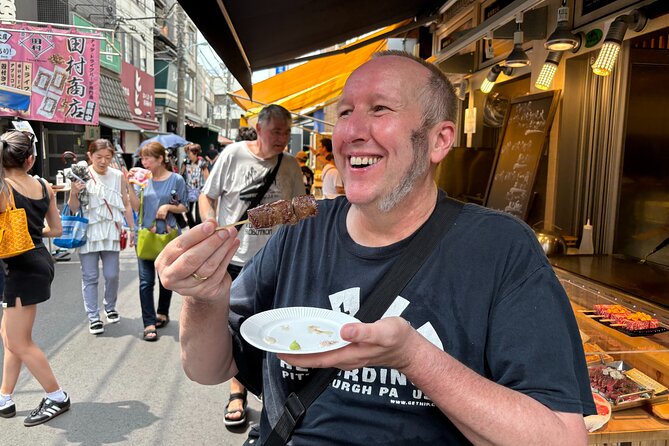
Tsukiji is best understood on foot, with a guide who can explain what you are seeing before you simply wander from stall to stall. This private two-hour tour pairs three local food tastings with visits to a Shinto shrine and a Buddhist temple, giving you both a bite of the market and a look at Japan’s layered religious life.
I like the private format, since you can set a comfortable pace and ask questions without a large group slowing you down. I also like that the food is chosen by the guide, not left as a vague promise to find something tasty on your own. The main consideration is depth: one past participant felt the explanations needed more detail, so this tour is likely best for a friendly introduction rather than a full study of Tsukiji’s past.
Key points to know before booking
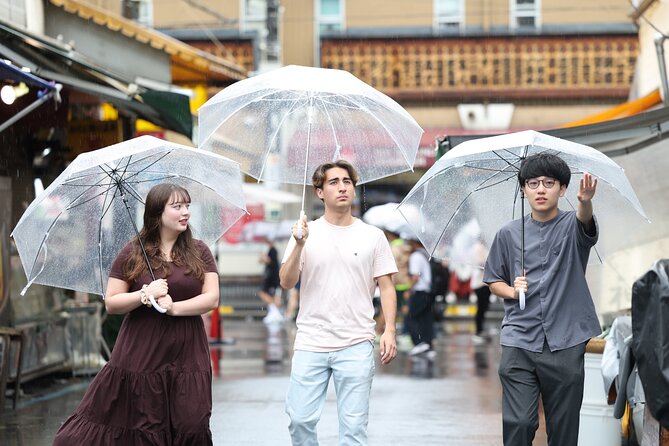
- Three included tastings: The guide selects three local foods, so you get a focused sample without paying separately for every planned bite.
- Two important religious stops: Namiyoke Inari Jinja and Tsukiji Hongan-ji show two different sides of Japanese worship.
- Private pace: You explore with your own group, not a mixed public crowd, which makes questions and small adjustments easier.
- Guides named Shuto and Sowar: Both received strong praise for friendliness, English ability, and adapting the walk to the group.
- A short market orientation: The tour gives you 55 minutes in the Tsukiji Outer Market, useful for getting your bearings before exploring further on your own.
- Good practical flexibility: You can cancel up to 24 hours ahead for a full refund, and reserve now while paying later.
Why Tsukiji works so well for a short food tour
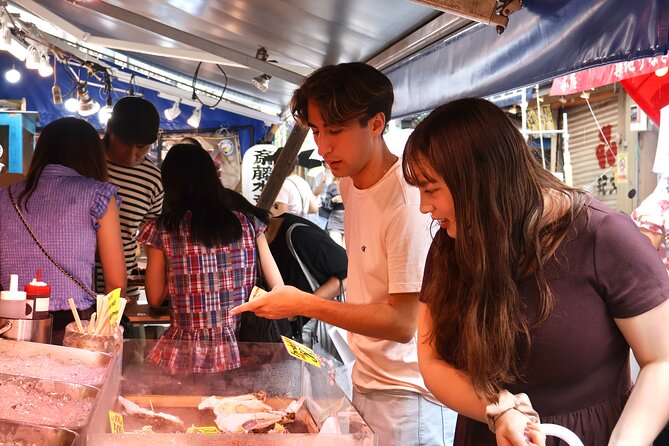
The old inner wholesale market moved to Toyosu, but Tsukiji’s Outer Market remains a major food area. That distinction matters. You are not joining a behind-the-scenes tour of the wholesale auction. You are walking through the public-facing market district, where food shops, small counters, and long-running culinary businesses serve people who come to eat and shop.
For a first visit, this is often the more useful part of Tsukiji. You can see the food culture at close range without needing a long explanation of auction rules or wholesale logistics. The challenge is that the market can feel like a maze of signs, counters, aromas, and narrow lanes. A local guide helps turn that confusion into a route.
The tour lasts two hours, which is enough time for a well-paced introduction. It is not long enough to cover every corner or provide a major historical lecture. I would think of it as a strong first look, especially if you plan to return later for more food or shopping.
More Fish Market Tours in Japan
- Tokyo Tsukiji Fish Market Food and Culture Walking Tour
★ 5.0 · 3,184 reviews - Tokyo: Tsukiji Fish Market Food and Walking tour
★ 5.0 · 1,724 reviews - Tokyo: Tsukiji Fish Market Guided Walking Tour
★ 4.9 · 1,397 reviews
Meeting at LAWSON Tsukiji 4 Chome Store
The walk begins in front of LAWSON Tsukiji 4 Chome Store. That gives you a clear meeting place, but arrive early. The no-show rule is strict after 15 minutes, and the scheduled tour time keeps running if you are late.
Your guide will be identified as the person waiting in front of the store. English and Japanese are available. The guide names connected with the experience include Shuto and Sowar. Shuto was praised for explaining how to pray at both the shrine and temple, while Sowar was noted for excellent English and for adjusting the route when the group did not want to eat so early.
That flexibility is useful, but you should tell the guide your needs at the start. If your appetite is not ready for food, the tasting plan may be adjusted, but the tour still begins at the booked time.
First stop: Tsukiji Uogashi Kaikobashi Building
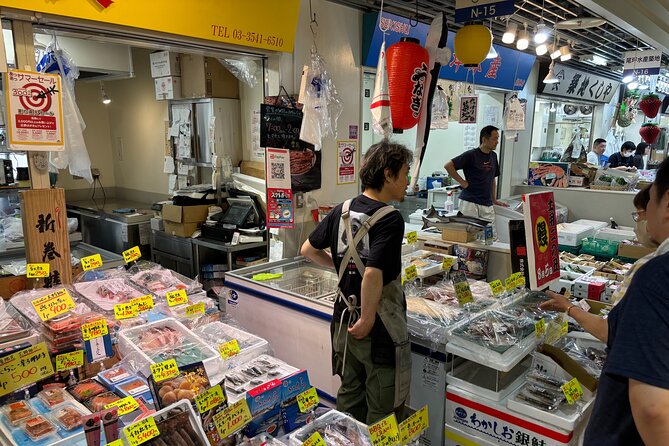
The first listed stop is the Tsukiji Uogashi Kaikobashi Building, with about 15 minutes set aside for a visit. This gives you an early look at the market area before the longer street-food portion of the walk.
The value here is orientation. Instead of starting with a random snack, you begin by seeing part of the market’s organized food-shopping side. Your guide can help explain how the area works and point out details that may be easy to miss when you are focused on finding your next bite.
The stop is brief, so do not expect a full tour of every shop or a long explanation at each counter. It works best as a scene-setting visit. If you want time to buy additional food, this is not the place to linger too long, since the route continues to the shrine and Outer Market.
Namiyoke Inari Jinja and the customs of prayer
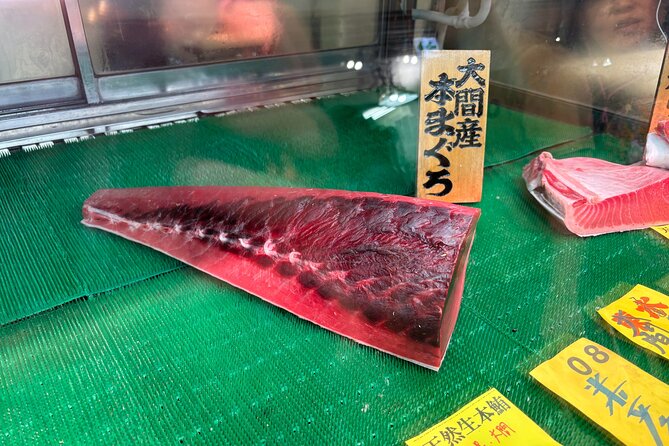
The walk then reaches Namiyoke Inari Jinja for about 10 minutes. This Shinto shrine has a close connection to Tsukiji’s working food community, making it a fitting stop in a market tour.
Ten minutes is enough for a calm introduction, but not a full religious history lesson. The guide can show you the basic way to approach and pray, which is especially helpful if this is your first visit to a Japanese shrine. Shuto was specifically praised for teaching these customs rather than simply pointing at the entrance and moving on.
I like this part of the route because it gives the market a human and cultural setting. Food here is not treated only as a product. The shrine visit offers a glimpse of the customs and beliefs woven into daily life around the market.
Keep in mind that this is a short stop. If you want to spend a long time observing the grounds or asking detailed questions about Shinto, you will probably need to return independently.
More Fish Market Tours in Tokyo
- Tokyo Sushi Making Class in Tsukiji with Professional Chef
★ 5.0 · 1,177 reviews - Tsukiji Fish Market Guided Tour and Sushi Making with Pro Chef
★ 5.0 · 775 reviews - Tokyo: Tsukiji Fish Market Food and Culture Walking Tour
★ 4.7 · 757 reviews - Tsukiji Fish Market: Street Food & Culture Walking Tour
★ 5.0 · 669 reviews
Fifty-five minutes among Tsukiji’s food stalls
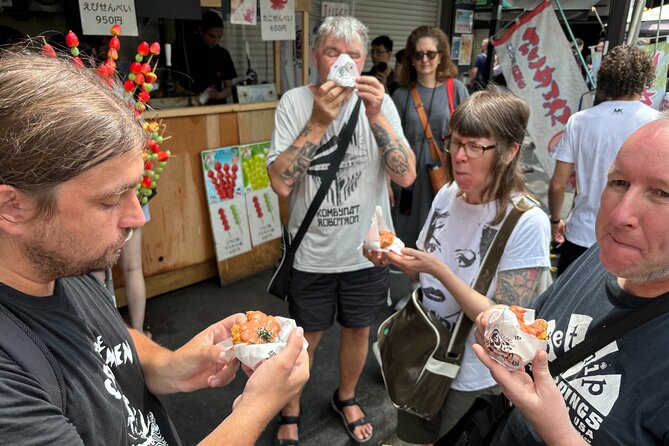
The longest portion of the route is the Tsukiji Outer Market, with about 55 minutes for street food, tastings, and a market visit. Three local foods are included in the tour price, selected by the guide.
The fact that the exact foods are not fixed is both a strength and a limitation. It allows the guide to choose local favorites and adapt to what is available. It also means you should not book this expecting a guaranteed list of named dishes. If you have allergies, dietary limits, or foods you cannot eat, contact the provider before booking and repeat the information to the guide.
The tastings give you a useful starting point. You can try three things without having to study every menu or decide how much food to buy. The guide can also point out places for extra snacks and drinks, as one Polish participant particularly appreciated the food and drink recommendations.
Still, three included samples are not a complete meal guarantee. The tour lists additional expenses separately, so plan to carry money for anything beyond the three included foods. I would use the tasting portion to find out what appeals to you, then return to a favorite stall if you want a longer lunch.
This is also where the quality of the guide matters most. A good guide will explain why a food matters, how it is normally eaten, or what makes a stall worth noticing. Several people enjoyed the friendly conversation and food choices, but one person felt the tour needed more context about the market and daily life. That is fair criticism to keep in mind. Ask questions. A private walk gives you the chance to guide the conversation toward food customs, market work, and local routines.
Tsukiji Hongan-ji brings a different mood
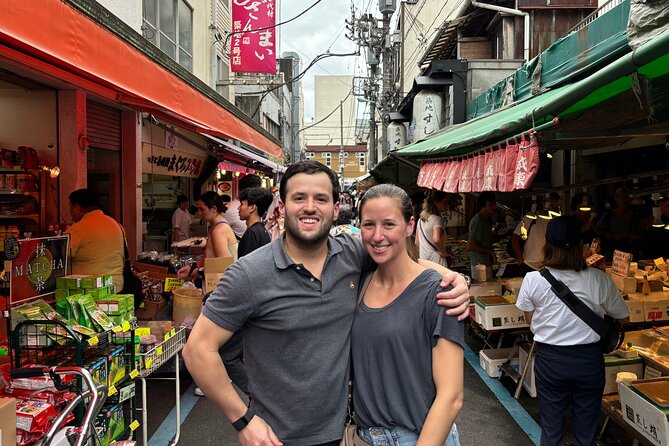
After the market, the tour visits Tsukiji Hongan-ji for about 30 minutes. This Buddhist temple gives the route a clear change of pace after the close quarters and food activity of the market.
Together, the shrine and temple are one of the best ideas in this tour. You are not seeing Japanese culture as one single tradition. You are visiting a Shinto site and a Buddhist temple in the same neighborhood, with the guide showing you basic customs at both.
The longer 30-minute temple stop should allow more time for sightseeing and questions than the brief shrine visit. The temple is also a useful place to pause and take in what you have seen. If the food market feels noisy or crowded, this stop provides a calmer finish.
As with the shrine, the tour does not promise an in-depth religious lecture. Its strength is contrast and access. You receive a practical introduction to two traditions during one compact walk.
Finishing near Tsukiji Station
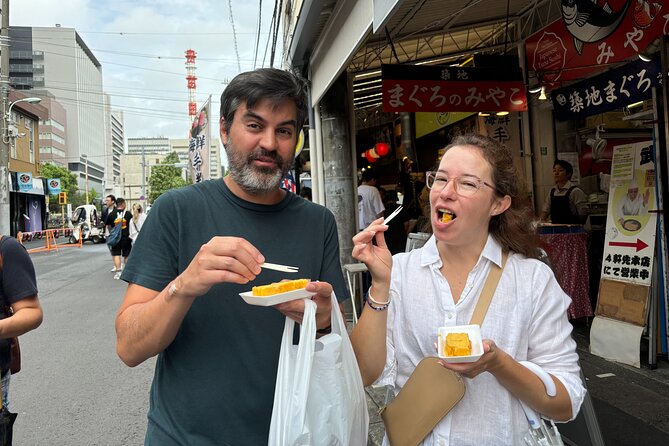
The tour ends at Tsukiji Station, which is convenient for continuing your day. You can leave directly for another Tokyo sight, stay in the area for more food, or return to a shop that caught your attention.
Ending at a station is especially helpful if you are using this as a first activity in Tokyo. You do not need to retrace the full route to find transportation. The tour’s compact layout also makes it easy to combine with nearby plans, though you should leave some breathing room if you are booking another timed activity.
The overall route includes roughly 15 minutes at the Uogashi building, 10 minutes at Namiyoke Inari Jinja, 55 minutes in the Outer Market, and 30 minutes at Tsukiji Hongan-ji. The remaining time covers walking and transitions. This is a walking experience, so wear comfortable shoes and avoid treating the schedule as a minute-by-minute guarantee.
How much value do you get for $49?
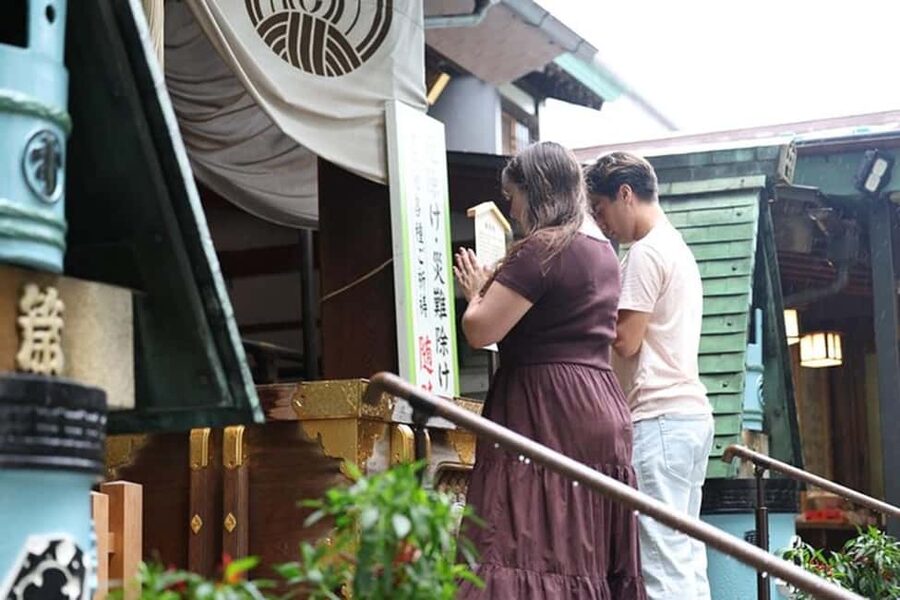
At $49 per person, the price is reasonable if you value private guiding and want three planned tastings. You are paying for a two-hour walk, a local guide, the three included foods, and photos sent after the tour. For a couple or family, the private format can be worth more than joining a larger group where questions and pace are less personal.
The value is less clear if you mainly want to eat. You could explore Tsukiji independently and spend your budget on extra food. The tour earns its price through structure, cultural context, and the help of a guide who can point you toward local choices.
Since additional expenses are not included, $49 is not the full food budget for the morning or afternoon. Think of it as the cost of a guided introduction with three included samples, not an all-you-can-eat market visit.
The reserve-now, pay-later option adds useful flexibility. You can hold a place without paying today, and cancellation is free up to 24 hours before the start. If you miss the meeting point by more than 15 minutes without contacting the provider, no refund is provided.
Who will enjoy this private walk most?
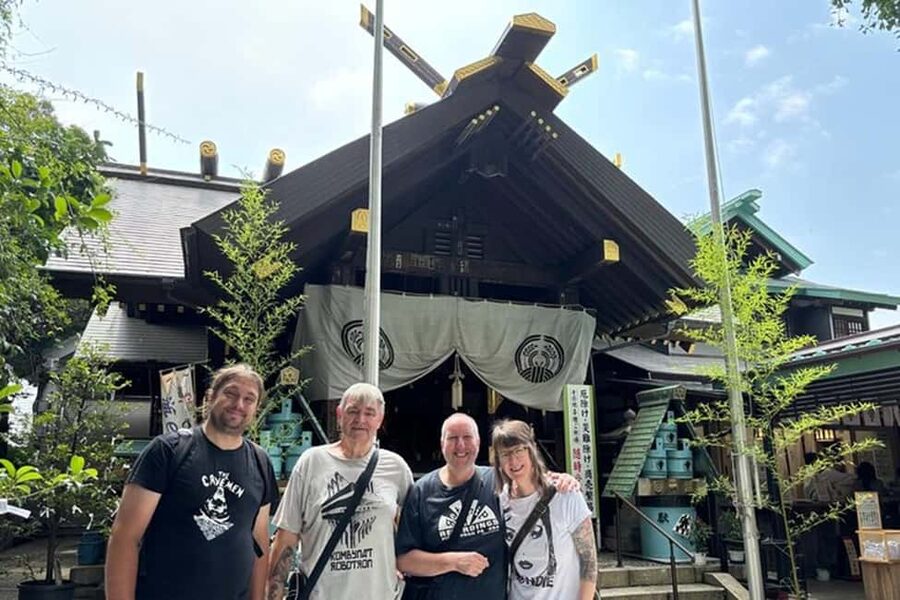
I would recommend it most strongly to first-time visitors who want help making sense of Tsukiji. It also suits couples, families, and small private groups that prefer a relaxed pace and direct access to a guide.
Food-focused visitors will appreciate the three selected tastings and the chance to receive further stall recommendations. People interested in Japanese customs will like the shrine and temple visits, especially if they want someone to explain how to pray.
The tour may be less satisfying if you want a detailed account of Tsukiji’s complete history, the wholesale market system, or every aspect of daily market work. One past participant found the explanations too light, and that is the key weakness to consider. The experience depends heavily on how much the guide explains and how actively you ask questions.
It is listed as wheelchair accessible, though the tour takes place on foot through a market area. If you use a wheelchair, confirm any particular needs with the provider before arrival so the guide can plan the route with you.
Should you book the Tsukiji private tour?
Book it if you want a short, private introduction that combines three food samples with two contrasting places of worship. The private setup, included tastings, friendly guide style, and useful food recommendations make it a practical first step into Tsukiji.
Skip it if you want a full meal, a fixed menu, or a long historical lecture. For the best experience, arrive early, tell the guide about dietary needs or a low appetite, and ask for the market stories and customs you care about most. At $49, it offers good value for personal attention and a clear first route through Tsukiji, as long as you see it as an introduction rather than the last word on the market.
FAQ
How long does the Tsukiji private tour last?
The tour lasts two hours, including the market visits, food tastings, shrine stop, temple stop, and walking between locations.
How much does the tour cost?
The listed price is $49 per person.
What food is included?
Three local foods selected by the guide are included in the tour price. The exact foods are not specified in advance.
Where does the tour begin?
The meeting point is in front of LAWSON Tsukiji 4 Chome Store.
Where does the tour finish?
The tour finishes at Tsukiji Station.
Is the tour private?
Yes. It is offered as a private group experience with no other participants added to your group.
Which languages are available?
Live guiding is available in English and Japanese.
Are extra food and drink purchases included?
No. Additional expenses are not included. The three selected food tastings are included, but other purchases cost extra.
What happens if I cancel or arrive late?
You can cancel up to 24 hours before the tour for a full refund. If you do not arrive within 15 minutes of the meeting time, it is treated as a no-show with no refund. If you expect to be late, contact the provider in advance.
More Private Market Tours in Tokyo
- Cairo 8 Hour Private Tour of Pyramids, Egyptian Museum and Bazaar
★ 5.0 · 2,931 reviews - Private Excursion to Maeklong Railway and Floating Markets
★ 5.0 · 850 reviews - Floating and Railway Market (Optional Waterfall): Private Tour
★ 5.0 · 827 reviews - Cairo: Private Pyramids, Museum & Bazaar Tour with Lunch
★ 4.6 · 744 reviews
More Private Market Tours in Japan
- Private Toyosu & Tsukiji Market Adventure with Tuna Auction
★ 4.8 · 191 reviews - Tsukiji Fish Market Private Food Tour in Tokyo
★ 5.0 · 18 reviews - Tokyo: Private Tsukiji Street Food & Sake with Local Guide
★ 5.0 · 3 reviews - Tuna Auction Market Guided Private Tour in Nachi-Katsuura
★ 5.0 · 43 reviews
Just added around Tokyo
- Tokyo: Tsukiji Market Guided Tour & Sushi-Making Experience★ 4.4 · 11 reviews
- Tokyo: Private Tsukiji Street Food & Sake with Local Guide★ 5.0 · 3 reviews
- Tokyo: Tsukiji Market and Hama-rikyu Gardens Guided Tour★ 4.8 · 73 reviews
- Tokyo: Tsukiji Fish Market Culture Tour with Sashimi Tasting★ 4.6 · 54 reviews
- Tokyo : Tsukiji Fish Market Food Walking & Shrine Visit Tour★ 5.0 · 3 reviews
- Tokyo: Tsukiji Fish Market Foodie and Educational Tour★ 5.0 · 4 reviews
- Tokyo’s Kitchen: Tsukiji Market Food & Culture Walk★ 4.7 · 74 reviews
- Tokyo: Guided Walking Tour of Tsukiji Market with Lunch★ 4.4 · 24 reviews
Fish Market Tours, compared.
Tokyo Tsukiji Fish Market Food and Culture Walking Tour
Read our review →

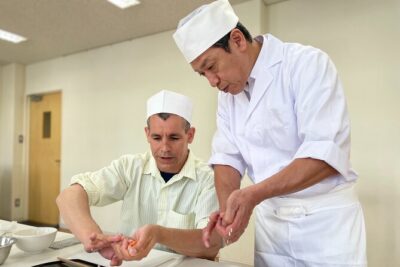
Tokyo Sushi Making Class in Tsukiji with Professional Chef
Read our review →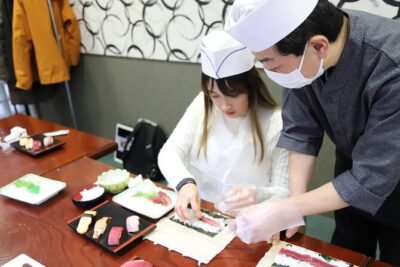
Tsukiji Fish Market Guided Tour and Sushi Making with Pro Chef
Read our review →Tsukiji Fish Market Food and Culture Walking Tour
Read our review →
Tsukiji Fish Market: Street Food & Culture Walking Tour
Read our review →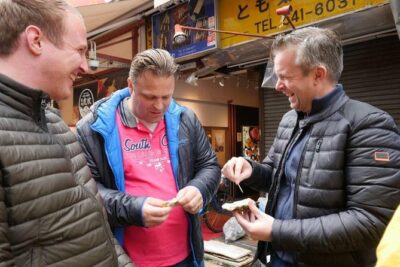
Tsukiji Fish Market Small-Group Food Walking Tour
Read our review →Browse the lists this tour appears in