
Review · FISH MARKET TOURS
Tokyo Morning Tour: Asakusa, Meiji Shrine and Tsukiji Fish Market
Tokyo can feel impossible to organize in a short visit, but this four-hour morning tour links three very different sights without asking you to wrestle with train maps. You begin at Meiji Jingu, pass through the food stalls and shops of Tsukiji, and finish at Senso-ji in old Asakusa.
I like the small maximum of eight people, which keeps the guide close and makes city walking less clumsy. I also like the practical photo service: guides such as Ryota, Yota, and Andres Burgos have been praised for finding good photo spots and keeping the schedule moving.
The trade-off is pace. One hour at each stop gives you a useful first look, not a leisurely study of Tokyo. You also pay about 600 yen for public transportation, and food at Tsukiji is extra.
Key points to know before booking
- Three major Tokyo sights in one morning: Meiji Jingu, Tsukiji Fish Market, and Senso-ji are spread across different districts, so this saves planning time.
- A group capped at eight: You get more direct contact with the English-speaking guide than on a large bus tour.
- An early start helps: The morning schedule is designed to reach popular places before they become more crowded.
- Tsukiji is a food stop, not a paid tasting tour: You can look around and buy food, but meals and drinks are not included.
- The route ends in Asakusa: This leaves you well placed to continue exploring the temple district on your own.
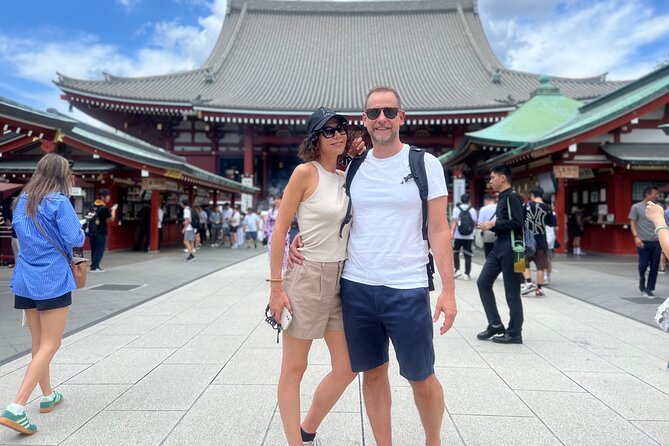
- Guided photos are part of the service: The guide can take pictures while also pointing out key details.
Why this compact Tokyo route works
This is a sightseeing sampler for a first morning in Tokyo. In four hours, you move from Shinto worship at Meiji Jingu to the city’s food culture at Tsukiji, then to Buddhist tradition and old shopping streets in Asakusa.
I like that the three stops do not feel repetitive. Each one shows a different side of the city. Meiji Jingu is quiet and wooded. Tsukiji is practical, noisy, and centered on ingredients. Senso-ji is theatrical, historic, and full of people moving through gates, shops, and temple grounds.
The route is especially useful if you have only a few days in Tokyo or if you want an orientation before exploring alone. Your guide handles the order of the stops and the public transportation between them, so you can pay attention to the city instead of checking a phone every few minutes.
The schedule also makes a sensible choice of starting point and finish. You meet near Harajuku, close to Meiji Jingu, then finish in Asakusa. You do not have to return to the starting point, and the end location gives you time to continue around Senso-ji, Nakamise street, or the wider Asakusa district.
More Fish Market Tours in Japan
- Tokyo Tsukiji Fish Market Food and Culture Walking Tour
★ 5.0 · 3,184 reviews - Tokyo: Tsukiji Fish Market Food and Walking tour
★ 5.0 · 1,724 reviews - Tokyo: Tsukiji Fish Market Guided Walking Tour
★ 4.9 · 1,397 reviews
Starting near Harajuku at Meiji Jingu
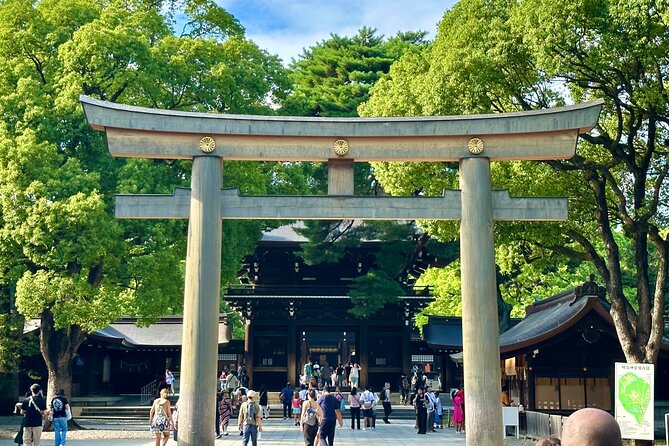
The tour begins at Starbucks Coffee near WITH HARAJUKU, at 1-14-30 Jingumae, Shibuya. From there, the first stop is Meiji Jingu, the Shinto shrine dedicated to Emperor Meiji and Empress Shoken.
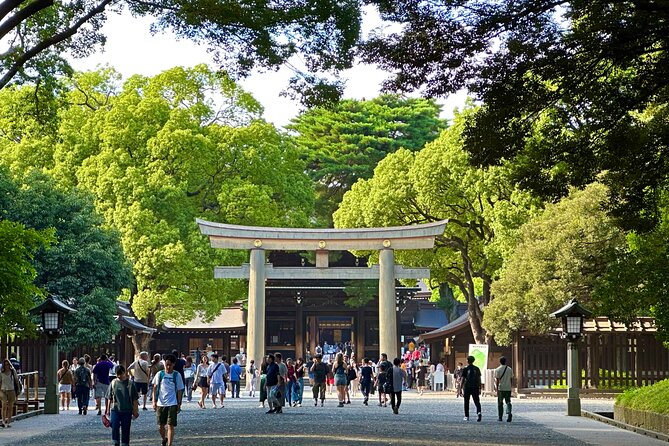
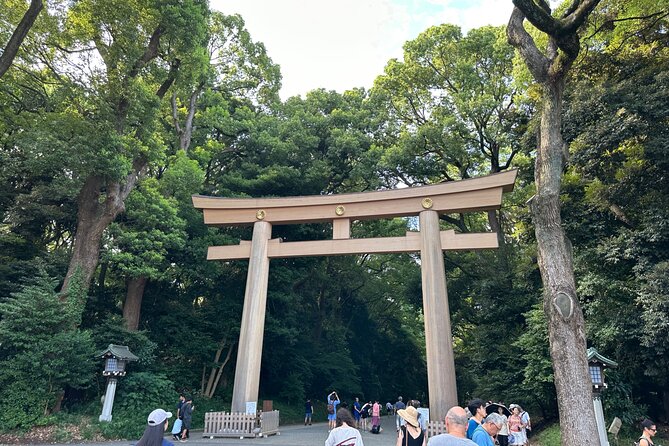
The approach is part of the experience. Meiji Jingu is surrounded by a large forested area, a striking contrast to the dense streets around Harajuku. Once you pass through the torii gates, the city noise gives way to broad paths and a calmer setting.
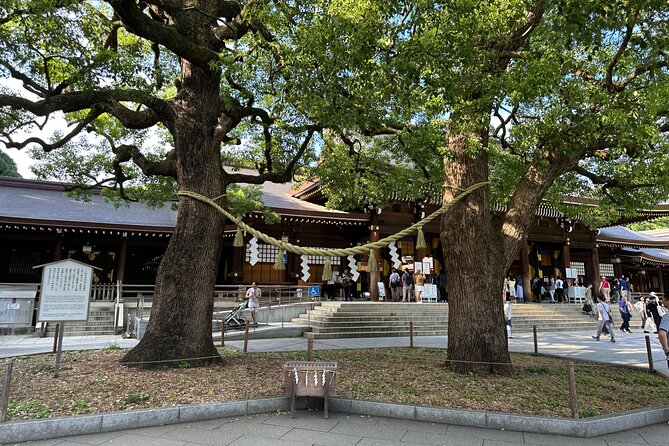
Your guide can explain the basic customs as you walk. That matters here because Meiji Jingu is not simply a monument to photograph. It is an active place of worship, and a little guidance helps you understand how to behave respectfully at the entrance and shrine buildings.
Allow about an hour. That is enough time to walk the main approach, see the torii gates, visit the shrine area, and hear the story behind the site. It is not enough for a slow wander through every path, so keep your expectations realistic.
I find this the best emotional opening to the tour. Tokyo can feel hard and fast at street level. Meiji Jingu gives you a quieter first impression and a chance to see how modern Tokyo makes room for religious tradition.
Comfortable shoes help from the start. The tour is active and includes walking between major sights, even though the overall route is guided and organized.
Reading Tokyo through Tsukiji’s food stalls
Tsukiji changes the mood completely. The former wholesale market moved its main operations elsewhere, but Tsukiji remains a major destination for seafood, produce, and food shopping. The tour presents it as a working food district with more than 80 years of market history.
This is where the guide’s commentary adds real value. A casual walk through Tsukiji can become a blur of stalls and unfamiliar ingredients. With someone explaining what you are seeing, the market becomes a window into Japanese cooking and the importance of fresh seafood.
You may see tuna, octopus tentacles, produce, and other ingredients used by home cooks and professional chefs. The market is also associated with high-end restaurant chefs who come in the morning to buy quality ingredients. You do not need to be a serious food lover to enjoy this stop, but curiosity helps.
The one-hour visit is best treated as a guided introduction rather than a full meal. Food and drinks are not included, so bring money if you want to sample something or buy a snack. The tour price covers the guided visit, not a tasting menu.
Tsukiji can also be the most unpredictable stop. Shops and food stalls create a lively setting, and the paths may feel tight when many people arrive. The early schedule is useful because it aims to get you through before the busiest part of the day.
Do not expect the old wholesale tuna auction experience here. The information provided for this tour centers on the current market district, its ingredients, shops, and food traditions. That is still worthwhile, but it is a different experience from visiting the former inner wholesale market.
Senso-ji and the old streets of Asakusa
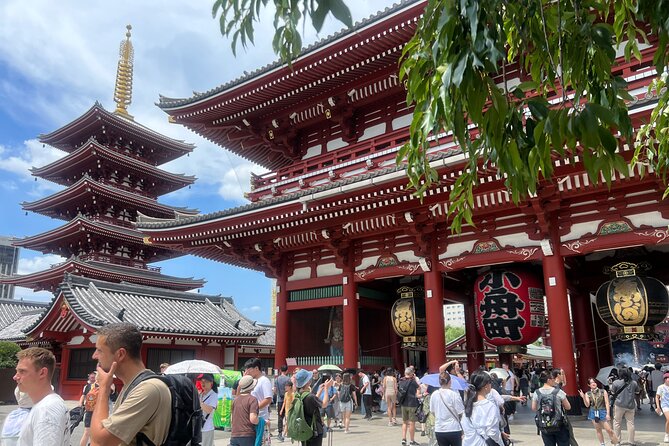
The final stop is Senso-ji in Asakusa, Tokyo’s oldest temple. This is the most visually dramatic part of the route, with the red Kaminarimon Gate, the long Nakamise shopping street, and the temple buildings beyond.
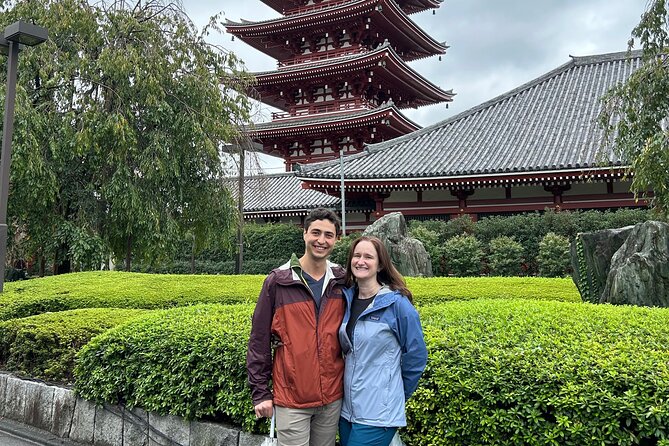
Kaminarimon is the famous entrance with its large lantern. It is a natural place for photos, and the guide can help you get a picture without leaving you to guess where the best angle might be. From there, Nakamise leads toward the temple with souvenir shops and traditional items on both sides.
Senso-ji feels different from Meiji Jingu. Meiji Jingu asks for quiet attention. Senso-ji is more public and theatrical, with a direct connection between worship, shopping, and sightseeing. The contrast gives the tour a useful shape.
The one-hour stop allows you to learn the main story, see the important gates and temple areas, and get oriented in Asakusa. It does not allow much time for a detailed look at every side street or for a long shopping session.
That is not a major flaw, because the tour ends here. Once the guide says goodbye, you can stay in Asakusa and explore at your own speed. You might continue along Nakamise, look for more local shops, or simply enjoy the district without having to follow the group.
For many people, ending at Senso-ji is more convenient than ending back in Harajuku. You finish in one of Tokyo’s most rewarding areas, rather than spending the last part of the morning retracing your route.
More Fish Market Tours in Tokyo
- Tokyo Sushi Making Class in Tsukiji with Professional Chef
★ 5.0 · 1,177 reviews - Tsukiji Fish Market Guided Tour and Sushi Making with Pro Chef
★ 5.0 · 775 reviews - Tokyo: Tsukiji Fish Market Food and Culture Walking Tour
★ 4.7 · 757 reviews - Tsukiji Fish Market: Street Food & Culture Walking Tour
★ 5.0 · 669 reviews
The value of a $157 half-day
At $157, this is not a cheap way to see Tokyo. You still pay about 600 yen for public transportation, and you cover your own food and drinks. If you are comfortable reading transit signs, planning routes, and researching each sight, you can visit these places independently for less.
The price makes more sense if you place value on time and guidance. These stops are not close together, and the tour includes an English-speaking guide, historical explanations, a small group, and photos. You are paying to connect three districts in a carefully ordered morning.
A group limit of eight is important here. A large group could make narrow market paths awkward and make it harder to hear explanations at the shrine or temple. With fewer people, the guide can answer questions, keep everyone together, and take photos without turning the outing into a slow production.
The strongest value is for a first visit. You get a quick map of Tokyo’s religious, culinary, and historic sides, then you can decide which district deserves a longer return visit. I would be less likely to book it if you already know these neighborhoods or if you prefer to spend half a day at one site.
The tour is also a reasonable choice for solo visitors and couples who want company without joining a large coach group. Families and older participants should consider the walking pace, but the activity information says most people can take part.
What the guides add to the morning
The guide is central to this experience. Without one, the route is simply three famous places connected by train rides. With one, the morning has a clear order and each stop has context.
Past departures have included guides named Ryota, Yota, and Andres Burgos. Ryota has been singled out for timing the route so the group reached each place before other groups arrived, while Yota has been described as approachable and helpful with explanations. Andres Burgos has also been praised for making the outing enjoyable and well organized.
The useful pattern is clear: you want a guide who can keep the group moving while still making room for questions. The schedule is tight, so good timing matters more than a long lecture at any one stop.
The photo service is another practical touch. You can ask the guide to take pictures at the major gates and shrine areas, which means you do not have to rely only on selfies. It also helps solo visitors who want a record of the morning.
Guide quality can vary from one departure to another, as it does on any guided activity. Still, the repeated emphasis on clear explanations, friendly help, timing, and photo spots suggests that the human side of this tour is one of its main strengths.
Timing, transport, and what to bring
The meeting point is Starbucks Coffee at WITH HARAJUKU, near Harajuku. Check the exact meeting time on your confirmation, since the experience is built around a morning start.
Public transportation is not included. The stated estimate is around 600 yen, so keep Japanese yen available in addition to the tour price. The guide leads the way, but you are still responsible for that fare.
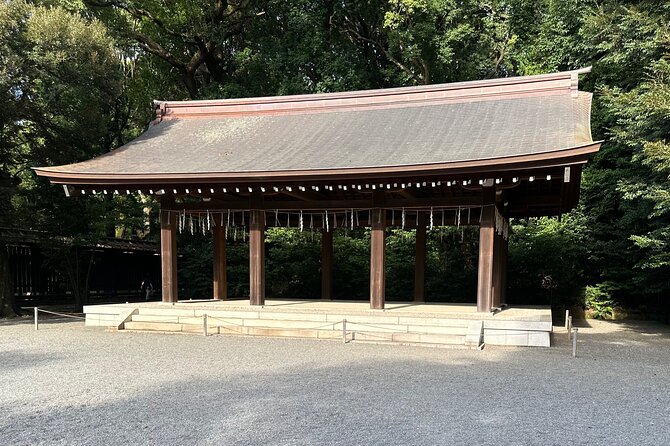
Wear shoes you can walk in for several hours. You will cover shrine paths, market streets, shopping lanes, and temple grounds. You should also allow time for standing, pausing, and moving with a small group.
Pack lightly. A small bag is easier in Tsukiji and on public transportation. If you hope to buy food or market items, leave room and carry some extra spending money.
The mobile ticket is convenient, and confirmation is provided when you book. The experience is near public transportation and finishes in Asakusa, not at the original meeting point.
Cancellation is free up to 24 hours before the start time for a full refund. Within 24 hours, cancellations and changes are not accepted for a refund. The tour also requires a minimum number of people, so a cancellation for that reason brings an offer of another date or experience, or a full refund.
Who should book this Tokyo morning tour?
I would choose this tour for a first-time visitor with limited time, especially someone who wants a useful introduction rather than a deep visit to one attraction. It also suits you if navigating Tokyo feels tiring, or if you want a small group and an English-speaking guide.
It is a good fit for solo visitors who appreciate help with photos and for couples who want the morning arranged for them. Food lovers will get the most from the Tsukiji stop, while people interested in Japanese religion will appreciate the contrast between Meiji Jingu and Senso-ji.
I would skip it if you want a relaxed pace, a long market breakfast, or hours inside one temple district. The three one-hour stops are efficient, but they leave little room for wandering off the planned path.
Should you book it?
Book this tour if your Tokyo schedule is tight and you want three major districts handled in one morning. The small group, guide-led route, photo help, and useful finish in Asakusa make the $157 price easier to justify for a first visit.
Skip it if your priority is saving money or exploring independently. You can visit the same areas on your own, but you will spend more time planning, navigating, and deciding what each place means. For a well-organized introduction with minimal fuss, this is a strong half-day choice.
FAQ
How long does the Tokyo morning tour last?
The tour lasts approximately four hours. Each of the three main stops receives about one hour.
Which places does the tour visit?
It visits Meiji Jingu Shrine, Tsukiji Fish Market, and Senso-ji Temple in Asakusa.
Where does the tour start and end?
The meeting point is Starbucks Coffee at WITH HARAJUKU in Jingumae, Shibuya. The tour ends in Asakusa, Taito City.
Is public transportation included?
No. Public transportation costs about 600 yen and are paid separately.
Are food and drinks included?
No. Food and drinks are not included, so you pay separately for anything you buy at Tsukiji or elsewhere.
How large is the tour group?
The tour has a maximum of eight people. An English-speaking guide leads the group, and photos taken during the tour are included.
Just added around Tokyo
- Tokyo: Tsukiji Market Guided Tour & Sushi-Making Experience★ 4.4 · 11 reviews
- Tokyo: Private Tsukiji Street Food & Sake with Local Guide★ 5.0 · 3 reviews
- Tokyo: Tsukiji Market and Hama-rikyu Gardens Guided Tour★ 4.8 · 73 reviews
- Tokyo: Tsukiji Fish Market Culture Tour with Sashimi Tasting★ 4.6 · 54 reviews
- Tokyo : Tsukiji Fish Market Food Walking & Shrine Visit Tour★ 5.0 · 3 reviews
- Tokyo: Tsukiji Fish Market Foodie and Educational Tour★ 5.0 · 4 reviews
- Tokyo’s Kitchen: Tsukiji Market Food & Culture Walk★ 4.7 · 74 reviews
- Tokyo: Guided Walking Tour of Tsukiji Market with Lunch★ 4.4 · 24 reviews
Fish Market Tours, compared.
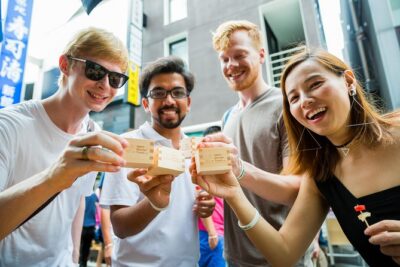
Tokyo Tsukiji Fish Market Food and Culture Walking Tour
Read our review →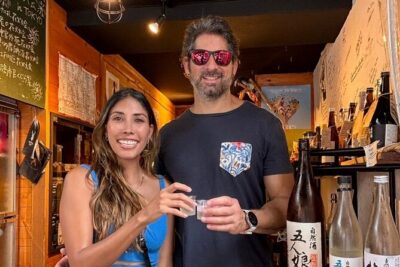
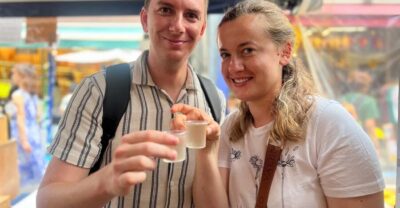
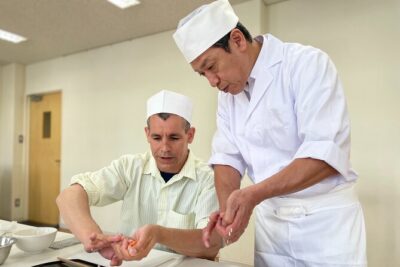
Tokyo Sushi Making Class in Tsukiji with Professional Chef
Read our review →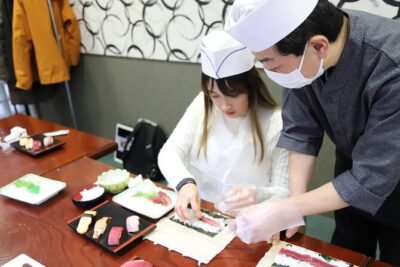
Tsukiji Fish Market Guided Tour and Sushi Making with Pro Chef
Read our review →Tsukiji Fish Market Food and Culture Walking Tour
Read our review →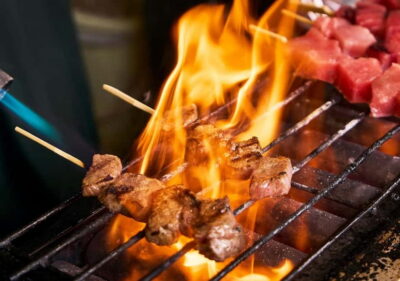
Tsukiji Fish Market: Street Food & Culture Walking Tour
Read our review →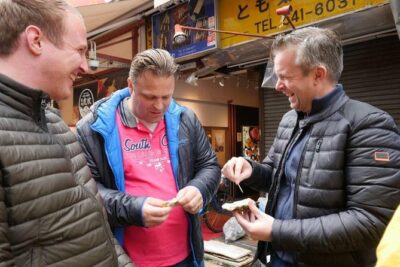
Tsukiji Fish Market Small-Group Food Walking Tour
Read our review →Browse the lists this tour appears in