
Review · MARKET WALKING TOURS
Bristol: Air Raid Shelter & St. Nicholas Market Walking Tour
The most unusual part of this Bristol walk happens below your feet. Beneath the Corn Exchange and St. Nicholas Market sits a preserved WWII air raid shelter, reached after a street tour through the old city. The guide, sometimes Owen, Duncan, or Theresa, may appear in wartime costume and turns a few dark rooms into a vivid account of life during the Blitz.
I like the way the tour joins two subjects that are often split apart: Bristol’s long trading story and its more recent wartime past. I also like the chance to see exclusive Corn Exchange rooms linked with 1960s music, including the Rolling Stones. The shelter is not a polished museum, though. Some areas need renovation, and you may want more time with the displays and objects.
Key points to know
- A rare underground visit: Enter Bristol’s largest public air raid shelter, a preserved space that is usually closed to casual visitors.
- A walk through wartime Bristol: See Blitz damage, the Temple Church and nearby old streets while learning how bombing changed the city.
- A guide-led performance: Owen, Duncan, and Theresa are praised for clear delivery, humor, costume, and strong personal commitment to the subject.
- Music history under the Corn Exchange: Visit rooms linked with major 1960s bands, including the Rolling Stones.
- Market time afterward: Finish near St. Nicholas Market, where you can buy sweet and savory food and browse souvenirs.
- Plan for uneven comfort: Comfortable shoes are essential, and the tour is not suitable for people with mobility impairments, claustrophobia, a weight over 300 pounds, or an age over 95.
Why this small tour reveals a different Bristol
Bristol is easy to approach through its harbor, street art, bridges, and famous food scene. This tour takes a quieter route. It begins at the Corn Exchange, then works through the old city before turning underground.
That change in setting gives the experience its shape. Above ground, you get architecture, trade, streets, and signs of wartime damage. Below ground, you face the practical reality of air raids: enclosed rooms, limited space, and the physical conditions civilians had to endure.
I would not choose this as a replacement for a full city sightseeing tour. It is more focused than that. The walk gives you a useful outline of Bristol’s past, but its real purpose is to reach the shelter and explain why preserving it matters.
The tour is also unusually personal. Duncan helped develop the project, while Owen is often described as an energetic storyteller who can bring the shelter to life. Theresa has also led the walk. The style can change slightly with the guide, but the central thread remains the same: Bristol’s trading past, its wartime experience, and the places hidden beneath the present-day city.
More Market Walking Tours in the UK
- Air Raid Shelter + St. Nicholas Market Walking Tour
★ 5.0 · 1,950 reviews - London Food Walking Tour: Taste Your Way Through Soho & Chinatown
★ 5.0 · 187 reviews - Food & drink walking tour in South East London. Bermondsey – Borough Market.
★ 5.0 · 79 reviews
Starting at the Corn Exchange
Meet outside the main entrance of the Corn Exchange. This is an important practical detail because the building has several sides and the activity does not begin inside the market itself.
The Corn Exchange is more than a meeting point. It connects Bristol’s commercial past with the tour’s later music and wartime stories. From here, your guide introduces the city’s role as a trading center and begins setting the scene for the old town.
Expect the guide to speak while the group remains on city streets, so clear delivery matters. Owen is particularly praised for speaking clearly, keeping the pace moving, and making the material accessible to different age groups. Duncan’s style is also described as humorous and highly committed to the subject.
You will want comfortable shoes from the start. The walking portion is not presented as a strenuous hike, but the full experience includes streets, stairs or changes of level, and an underground shelter. People with mobility limits should check carefully before booking.
Bristol’s old streets and the damage left by the Blitz
The first major section leads through Bristol’s old city. Your guide discusses roughly 1,000 years of trading activity and points out architecture that makes more sense once you understand the city’s commercial life.
The wartime section becomes more specific as you approach places affected by bombing, including the Temple Church, Wine Street, and Corn Street area. The point is not simply to list dates or battle facts. You begin to see how air raids altered familiar streets and how the shelter below them fitted into ordinary city life.
This part is especially useful if you already know Bristol. Several local residents have found that the walk adds details they had never encountered, even after living in the city for years. That is a good sign for the quality of the route: it does not assume that only first-time visitors need a guide.
The street portion also helps you picture the shelter in context. You are not entering an isolated wartime attraction somewhere outside town. You are walking through the same commercial center where people worked, shopped, and moved about before descending below ground for protection.
The drawback is that the tour’s subject is broad. You hear about ancient trade, old buildings, wartime destruction, modern Bristol, and the market. If you want a tightly focused military tour, some of the wider city material may feel like a lead-in rather than the main event.
Going below ground into the air raid shelter
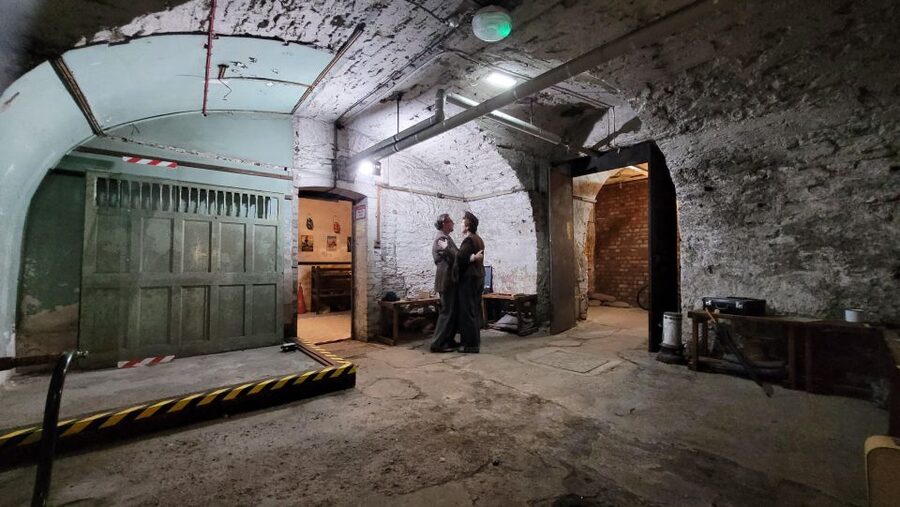
The shelter is the reason to book. After the street walk, your guide leads the group beneath the Corn Exchange area and into Bristol’s largest public air raid shelter.
This is not a glossy attraction with a large modern gallery. It is valued precisely because it feels like a preserved place rather than a reconstructed set. The rooms remain stark, and the project is still developing its museum displays. You can see wartime objects and information panels, but the available exhibition space is limited.
That unfinished quality has two sides. It gives the shelter an honest, untouched feel, and it lets the guide remain central to the experience. At the same time, you may wish for more time to examine the objects. Some people have wanted longer for questions and for reading the material at the end.
Your guide supplies much of the interpretation. Owen is known for helping people imagine what it must have been like to wait underground during an air raid. Duncan brings personal drive to the preservation work and explains the site with a strong sense of purpose.
The setting itself does much of the work. A museum case can show you a helmet, a household object, or a wartime notice. In the shelter, you see the rooms where people actually took cover. The atmosphere is restrained rather than theatrical, although a guide in WWII costume adds a touch of character.
There is also a light ghost-story element. You might hear about Margaret, described as a friendly ghost, and perhaps see a group photograph connected with her. Treat that as a playful extra, not the central reason for visiting. The serious value is the surviving shelter and the account of civilian life during bombing.
More Market Market Walking Tours in the UK:
- Christmas Lights and Markets Guided Walking Tour with Mulled Wine
★ 5.0 · 72 reviews - London Private Walking Tour: Notting Hill, Highlights & Markets
★ 4.5 · 22 reviews - London: Authentic London Sunday Markets Walking Tour
★ 5.0 · 15 reviews - London: Markets, Street Art, and Camden Town Walking Tour
★ 5.0 · 5 reviews
A preservation project rather than a finished museum
You should set your expectations before entering. This is a working historical attraction with room to grow, not a major museum with extensive interpretation in every chamber.
That limitation is important for two reasons. First, the tour depends heavily on the guide. A strong guide fills in what the displays cannot. Owen, Duncan, and Theresa are all associated with lively delivery, clear explanations, and an ability to keep the group involved.
Second, your ticket helps draw attention to a site that many people in Bristol did not know existed. Several visitors have expressed concern that the shelter needs greater care and support. You can see why once you visit: the place has real educational value, but it needs investment if it is to become a fuller museum.
I appreciate that the tour does not try to hide this. The shelter’s rough edges are part of the experience. Still, if you need polished galleries, extensive labels, or a long period of quiet self-guided browsing, you may find the visit limited.
For most people, the best approach is to see the guide as the main interpreter and the shelter as the evidence. Listen closely during the talk, then use any available time at the end to inspect the articles and displays.
The Corn Exchange’s 1960s music connection
The tour includes access to areas of the Corn Exchange that are normally unavailable. These rooms are linked with the best bands of the 1960s, including the Rolling Stones.
This detail broadens the experience in a useful way. The building is not only a commercial landmark or a wartime meeting point. It also carries a connection to Bristol’s music past. The subject arrives briefly within a tour centered on trade and war, but it adds another layer to the building.
Do not book this solely as a rock music tour. The music rooms are one feature among several, and the exact amount of time spent there may depend on the pace of the group and the guide’s presentation. If you like places with several lives, though, this is one of the more appealing parts.
It also helps explain why the Corn Exchange works so well as the starting point. The tour moves from commerce to conflict to popular culture, all around the same central Bristol site.
Ending at St. Nicholas Market
The route finishes at or near St. Nicholas Market, depending on the day’s arrangement. This is where the history walk turns into a practical lunchtime stop.
Food is not included, so bring extra money if you want to eat. The market offers sweet and savory choices, and you can also browse for small souvenirs. This makes the ending flexible: you can grab something quickly, stay for a meal, or continue exploring Bristol independently.
The market is also a useful reason to choose a morning booking. Once the guided portion ends, you are already in the right place for food rather than needing to cross the city. One local family found the tour short enough to leave time for the market afterward.
The timing needs a little care. The activity is advertised at between 75 minutes and two hours, while the route details divide time between the old city and St. Nicholas Market in a way that suggests a longer maximum. In practice, plan for roughly an hour and a quarter to two hours, depending on the guide, group, and time spent underground. A visitor reported a tour of about one hour and 15 minutes, while others described two hours well spent.
What $16 buys you
At $16 per person, this is a strong-value choice if you want access to places you cannot simply enter on your own. The price includes the guide, the WWII shelter, and restricted Corn Exchange areas.
The value comes from access rather than quantity. You are not paying for a long list of monuments or a large museum complex. You are paying for the guide’s interpretation and for entry to a shelter that is usually unavailable to the public.
Food and drink cost extra at St. Nicholas Market. That is reasonable because you can choose what and whether to buy. I would budget separately for lunch, especially if you plan to remain in the market after the tour.
The flexible booking terms are useful if your Bristol plans may change. You can cancel up to 24 hours before the start for a full refund, and the reserve-now, pay-later option lets you hold a place without paying immediately.
Who will get the most from this walk
I would recommend it most strongly to:
- People interested in WWII and civilian life during bombing
- Bristol residents who want to learn about familiar streets in a new way
- Visitors who enjoy local stories more than broad panoramic sightseeing
- Families with older children who can manage an underground setting
- Music fans curious about the Corn Exchange’s 1960s links
- Anyone who likes developing historic sites and guide-led interpretation
I would be more cautious if you dislike enclosed spaces or have difficulty walking. The activity is specifically unsuitable for people with claustrophobia, mobility impairments, a weight over 300 pounds or 136 kilograms, and people over 95 years old.
The English-only format matters, too. The live guide speaks English, and the experience depends on listening to stories rather than reading a multilingual display.
Small details that make the visit better
Arrive at the main entrance of the Corn Exchange, not simply at St. Nicholas Market. Wear shoes that are comfortable for city walking and suitable for an underground site.
Keep your schedule loose after the tour. You may finish in 75 minutes, or you may spend closer to two hours with the group. Leaving room for food at St. Nicholas Market means you will not feel rushed.
Listen for the transition between city history and personal wartime experience. The shelter is most effective when you understand the streets above it first.
If you are keen on the objects and developing museum displays, ask your guide how much time will be available to look at them. Some groups have wanted more time for questions and close viewing, so this is worth knowing in advance.
Should you book the Bristol air raid shelter tour?
Book it if you want Bristol history with a strong sense of place. The shelter is unusual, the Corn Exchange access is special, and the best guides, including Owen and Duncan, make the material clear, warm, and memorable.
Skip it if you need a polished museum, a fully accessible route, or a long self-guided visit with extensive displays. The shelter still needs restoration and development, and the underground rooms may feel confined.
For $16, I think the combination is worthwhile: old streets, Blitz damage, a preserved shelter, music history, and an easy finish at St. Nicholas Market. It is a compact tour, but it gives you a part of Bristol that you would almost certainly miss while walking around on your own.
FAQ
Where does the tour begin?
Meet at the main entrance of the Corn Exchange in Bristol.
Where does the tour finish?
The tour has drop-off points at St. Nicholas Market and the Corn Exchange.
How long does the experience last?
The stated duration is between 75 minutes and two hours. The exact length depends on the schedule and how the guided visit runs.
What language is the tour in?
The live guided tour is in English.
Is entry to the air raid shelter included?
Yes. Entry to the WWII air raid shelter and exclusive areas of the Corn Exchange is included with the guided tour.
Is food included?
No. Food and drinks are available to purchase at St. Nicholas Market after or during the market portion of the experience.
Who should not book this tour?
The tour is not suitable for people with mobility impairments, claustrophobia, a weight over 300 pounds or 136 kilograms, or people over 95 years old.
Just added around the UK
- Self-Guided Craft Beer Tour (Explore Old Market)★ 4.5 · 19 reviews
- Discover Belfast with St. George’s Market Minivan Tour★ 5.0 · 4 reviews
- Secrets of London Bike Tour: Thames, Tower Bridge & Market★ 4.8 · 42 reviews
- London: Markets, Street Art, and Camden Town Walking Tour★ 5.0 · 5 reviews
- London: Borough Market Food Tour with Local Guide★ 4.6 · 19 reviews
- London Ultimate East End Food & Market Tour with a Local★ 5.0 · 3 reviews
- London: Indian Cooking Masterclass with Market Tour★ 5.0 · 3 reviews
- London: Authentic London Sunday Markets Walking Tour★ 5.0 · 15 reviews
Market Walking Tours, compared.

Tokyo Tsukiji Fish Market Food and Culture Walking Tour
Read our review →


Nishiki Market Brunch Walking Tour (7 Tastings + Brunch)
Read our review →Tsukiji Fish Market Food and Culture Walking Tour
Read our review →
Tsukiji Fish Market: Street Food & Culture Walking Tour
Read our review →
Tsukiji Fish Market Small-Group Food Walking Tour
Read our review →Browse the lists this tour appears in