
Review · ROME MARKET TOURS
Rome: Trajan Markets Experience with Multimedia Video
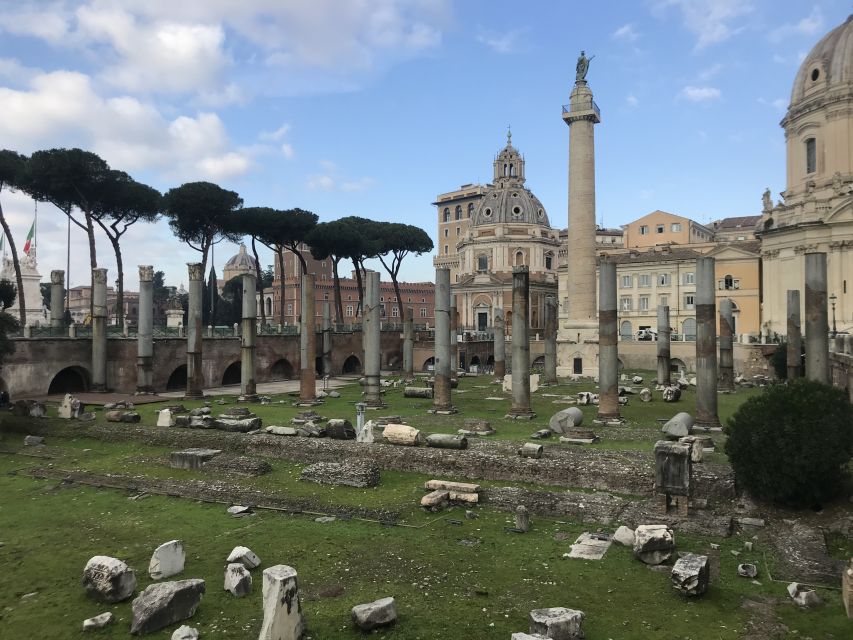
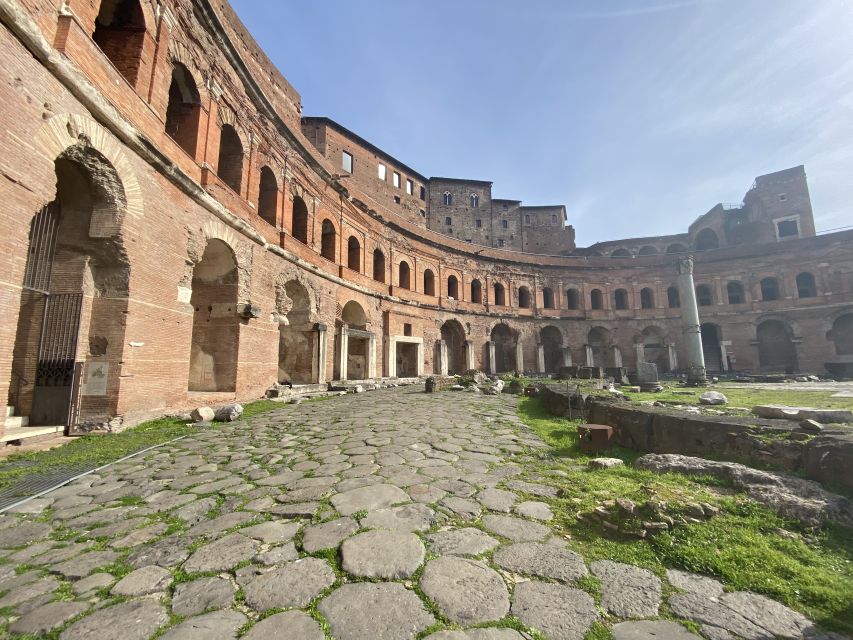
Rome’s Trajan Markets are more than a pile of old walls. They form a sweeping, semi-circular complex that once helped run the commercial life of Imperial Rome. The 25-minute Ancient Rome video gives you a useful visual introduction before you walk among the ruins, while the Fori Imperiali Museum adds artifacts and amphorae to the grand stone setting.
I especially like the combination of Trajan Markets and the Imperial Forums, since you see both the practical side of Roman life and the public spaces where power and trade met. The downloadable app, with more than 170 points of interest, also lets you explore at your own speed. The main drawback is that this is not a live guided tour, and ticket collection can take extra time, so do not arrive at the last minute.
Key points to know before booking
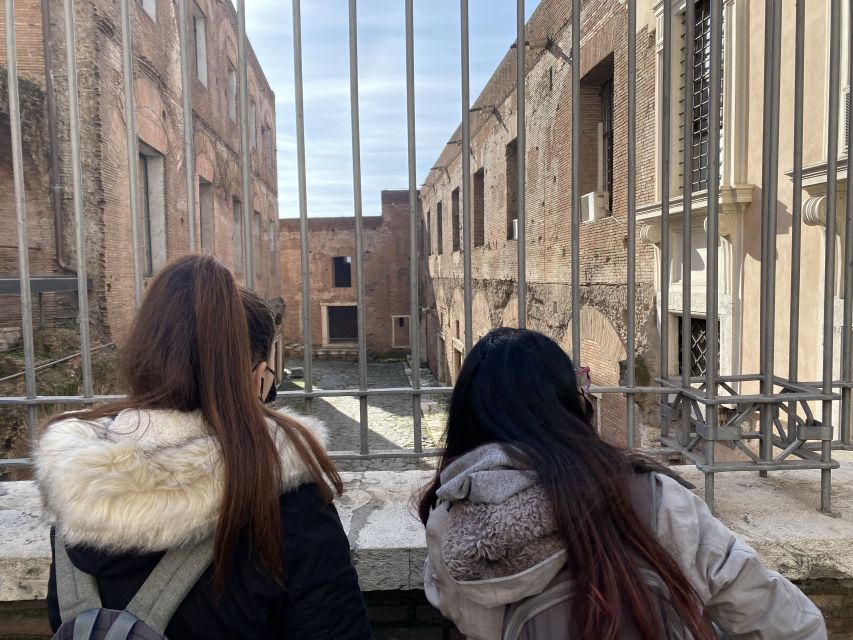
- See Rome’s ancient shopping district: Trajan Markets reveal how commerce, storage, and movement worked in the Imperial capital.
- Begin with a 25-minute history video: Reconstructions help you picture monuments that now survive only as ruins.
- Explore four major forums: The route includes Caesar’s Forum, Augustus’ Forum, Nerva’s Forum, and the Templum Pacis.
- Use the 170-point city app: Your smartphone becomes an audio guide for the archaeological area and other points around Rome.
- Visit the Fori Imperiali Museum: Ancient artifacts and amphorae add human scale to the monumental ruins.
- Allow time at the meeting point: The Touristation office is easy to identify, but ticket printing has not always been quick.
Starting at Piazza d’Aracoeli
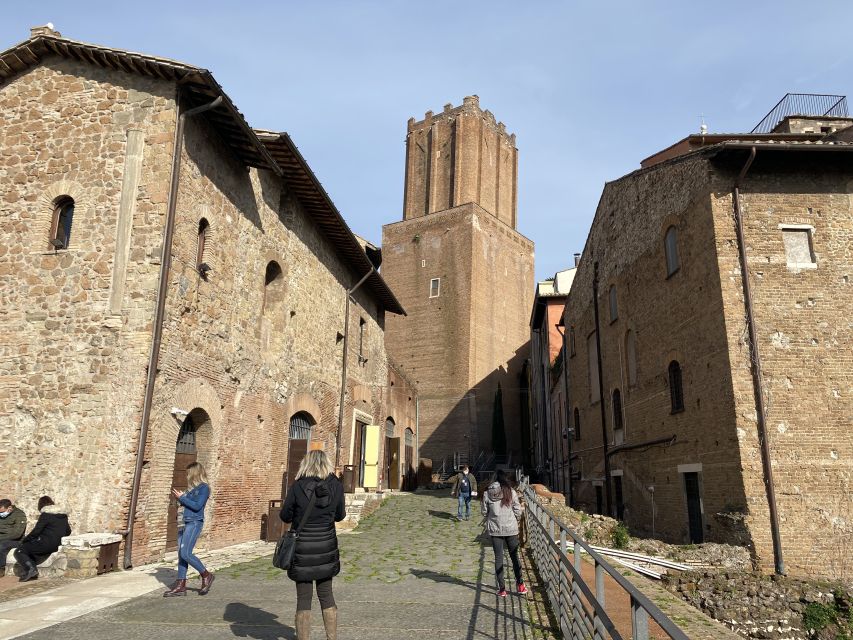
Your visit begins at the Touristation Aracoeli office at Piazza d’Aracoeli 16, near Piazza Venezia. Look for the orange Touristation flags and the fountain in front of the entrance. This is a busy central part of Rome, so give yourself enough time to find the office rather than treating the meeting point as a quick formality.
You first watch a 25-minute multimedia presentation about Ancient Rome. It reconstructs important monuments and shows how the city looked during its Imperial period. That matters here because many of the forums are now a mixture of foundations, broken columns, walls, and open archaeological ground.
A video cannot replace standing beside the ruins, but it can help you read them. Instead of seeing only scattered stones, you get a picture of the buildings, streets, and public spaces that once filled this part of Rome.
The video is also useful if you are new to Roman archaeology. The Imperial Forums can feel confusing at first because several building projects overlap in a compact area. A visual introduction gives you a basic map before you begin looking at the remains.
A few more market tours around Rome worth a look
- Rome: Colosseum, Roman Forum & Trajan’s Market Exterior Tour
★ 4.3 · 2,038 reviews - Roman Food Tour with Visit to the Trionfale Food Market
★ 5.0 · 471 reviews - Authentic Roman Cooking Class & Market Experience
★ 5.0 · 363 reviews
What the Trajan Markets reveal about Roman commerce
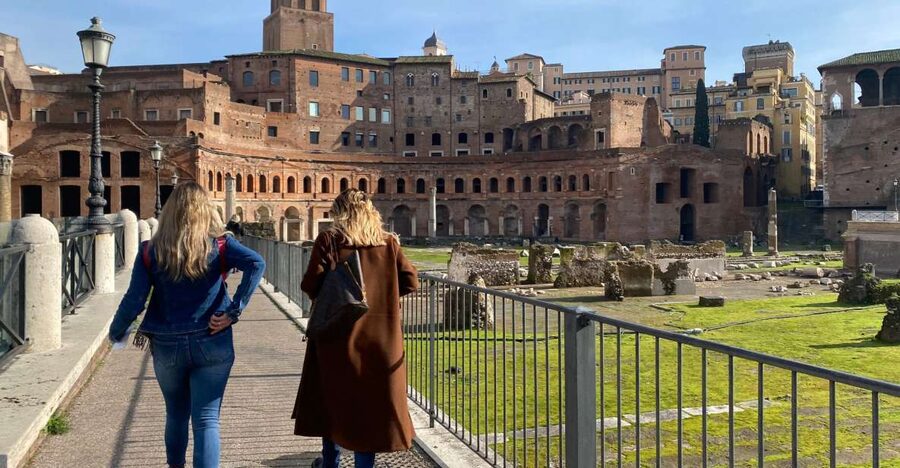
The Trajan Markets are the central reason to book this experience. Often described as the commercial shopping mall of the Roman Empire, the complex shows a side of Rome that the grand temples and triumphal monuments can hide.
This was a place connected with trade, storage, shops, and daily business. The architecture is especially striking because of its curved, semi-circular form. That shape is one of the most memorable features of the site, and it gives the complex a different feel from the straight lines of many Roman streets and temples.
As you walk through the archaeological complex, look beyond the impressive brickwork. Think about the practical problem the Romans were solving: how to organize goods and commercial activity in a huge capital city. The site helps you picture Rome not just as a center of emperors and armies, but as a city that needed food, tools, pottery, clothing, and countless other supplies.
The experience is strongest when you take your time. You are not simply passing a monument for a photograph. You are looking at the remains of a working urban district, where commerce and public life were closely linked.
Following the Imperial Forums from Caesar to the Templum Pacis
The visit also connects the Trajan Markets with several major forums. These spaces served as trading areas, meeting places, and public centers, but each belongs to a different phase of Rome’s development.
Caesar’s Forum helps show how leaders used architecture to shape the city and reinforce their authority. Augustus’ Forum continued that pattern, linking public space with political power and imperial image. The buildings were not only practical. They told Romans who ruled and how Rome understood itself.
You also encounter Nerva’s Forum and the Templum Pacis. Together, these areas show the city changing over time. New emperors added buildings, altered older spaces, and connected their own rule with the achievements of earlier leaders.
That long sequence is one of the best reasons to use the app. Without some explanation, it can be difficult to understand why several forums sit so close together or how they relate to one another. Audio points can give you the names and background as you stand near each section.
The app contains more than 170 points of interest and is downloaded to your smartphone. It is not a live guide walking beside you, so you need to manage the experience yourself. That suits visitors who prefer stopping for photographs, moving slowly through a section, or skipping information that feels less relevant.
Bring headphones. They are specifically recommended, and they make the audio easier to follow in an open archaeological setting.
The 17th-century cistern and the later life of the site
One of the more unusual details is a cistern from the 17th century. It reminds you that this area did not stop mattering when the Roman Empire disappeared.
Rome’s ruins were reused, adapted, and absorbed into later city life. The cistern points to a much later purpose, long after the forums had ceased to function as Imperial commercial and civic centers. It is a small feature compared with the monumental markets, but it adds an important layer to the visit.
I like this kind of detail because it prevents the site from becoming a single-period display. You are not seeing only ancient Rome preserved under glass. You are seeing a place that changed functions across centuries.
The cistern also gives you a useful reminder: archaeology is rarely a neat story with one date and one purpose. Buildings survive in fragments, and later generations often put old spaces to new uses.
Same place, a different set of stalls:
- Taste of Testaccio: Special 15 Year Anniversary Edition
★ 5.0 · 1,658 reviews - Trevi Fountain, Pantheon, and Campo Dei Fiori Market Food and Wine Tour
★ 5.0 · 320 reviews - Rome: Pasta Cooking Class with Market Visit and Wine
★ 4.9 · 277 reviews - Rome: Food Tour with Market Visit
★ 4.9 · 200 reviews
Inside the Fori Imperiali Museum
After the outdoor archaeological area, you visit the Fori Imperiali Museum. The collection includes artifacts from ancient cultures and a group of amphorae.
The museum helps answer questions that the ruins alone cannot. The forums and markets show the scale of the city, but objects reveal the materials and goods connected with everyday life. Amphorae, in particular, bring trade into clearer focus. These containers were used throughout the ancient Mediterranean world, and their presence fits naturally with a site devoted to commerce.
The museum is not simply an extra room added to the ticket. It gives you a chance to slow down and look at objects rather than architecture. One part of the visit is about streets, walls, and large public buildings. The other is about portable things made, moved, stored, and used.
If you are mainly interested in dramatic ruins, the outdoor complex will probably be your favorite section. If you enjoy artifacts and close-up details, the museum may be where the visit becomes most rewarding. The two parts work best together.
How the multimedia format works
This experience combines three elements: the video, the archaeological site, and the smartphone audio app. The format gives you structure without putting you into a fixed, live tour group.
The video comes first and lasts 25 minutes. After that, you explore the Trajan Markets and the Imperial Forums. The app provides more than 170 listening points across the city, so it can offer context well beyond one building.
That large number of points can be useful, but it also means you should not feel obliged to listen to everything. Pick the sections that match what you are seeing. If you try to absorb every available point, the visit could become more about managing your phone than looking at Rome.
You need a charged smartphone and headphones. The app is part of the experience, not an optional paper map. If your battery is low, charge it before arrival. The information provided does not state that a live guide accompanies you, so plan for a self-guided visit.
This format suits independent visitors, couples, and families who want flexibility. It is less suitable if you want a historian answering questions in real time or adjusting the explanation to your interests.
Is $37 a fair price?
At $37 per person, the value depends on how much use you make of the included extras. You receive the 25-minute video, admission to Trajan Markets, admission to the Fori Imperiali Museum, and the city audio app.
For someone who wants only to look at the ruins from outside, the price may feel high. A portion of the archaeological area can be seen from the street, and one visitor felt that the extra multimedia package was not useful for their needs.
For someone who wants more context, the calculation is better. The video provides a visual introduction, entry takes you beyond the street views, the museum adds artifacts, and the app offers a substantial amount of audio material. You are paying for interpretation as well as access.
The price also works best if you plan to use the app beyond a quick walk through the markets. More than 170 points of interest is a lot of material, though you will need to decide how much fits your day.
I would book it for a visitor who wants a self-guided archaeological experience with built-in explanation. I would think twice if you already have a strong guidebook, prefer live commentary, or mainly want a quick look at the exterior.
Allow extra time at the Touristation office
The meeting point is straightforward, but ticket collection may not always be instant. One booking record describes an afternoon visit where the voucher was exchanged successfully in the morning, with a friendly welcome and no queue. Another describes at least 15 minutes spent waiting for tickets to be printed and confusion during the process.
The practical lesson is simple: do not schedule this back-to-back with another timed attraction. Arrive early enough to allow for ticket printing, staff assistance, and the short video before your site visit.
The office is near Piazza Venezia, an area where you may already be visiting major sights. Still, the fact that it is central does not mean you should arrive only a few minutes before your selected start time.
The experience is valid for one day, and starting times depend on availability. It is also possible to reserve now and pay later, with free cancellation up to 24 hours in advance. Those terms are helpful if your Rome plans are still shifting.
Who will enjoy this experience most?
I would recommend it to you if you like history but do not want to commit to a full live tour. The app lets you control the pace, and the video gives you enough background to make the ruins easier to understand.
It also suits visitors who want more than the standard Roman sights. Trajan Markets offer a look at trade and urban organization, not just emperors, battles, and temples.
Families may appreciate the reconstructed images in the video, though the site itself involves uneven archaeological ground. Comfortable shoes are required, and the experience is not suitable for wheelchair users.
You should choose another format if you need personal assistance, a fully guided route, or a highly specialized archaeological lecture. The attraction provides access and audio material, not a named expert guide accompanying you through every section.
Leave food and drinks out of your planning for this activity, since they are not included. Large bags, luggage, drones, glass objects, sprays, weapons, alcohol, and drugs are not allowed. Pets are also not permitted.
Should you book the Trajan Markets experience?
Book this if you want to understand Rome as a working city, not only as an imperial stage. The curved Trajan Markets, the sequence of forums, the later cistern, and the museum’s amphorae give you several ways to think about the site.
The best value comes from using all three parts: watch the video, explore beyond the street view, and listen to selected app points. Arrive early at Piazza d’Aracoeli, bring headphones, and keep your phone charged.
Skip it if you want a live guide or a short, simple monument visit. For an independent visitor who enjoys setting the pace and wants context for the Imperial Forums, $37 is a reasonable price, provided you actually use the museum and multimedia materials.
FAQ
Where does the experience begin?
Meet at the Touristation Aracoeli office at Piazza d’Aracoeli 16, near Piazza Venezia. Look for the orange Touristation flags and the fountain in front of the entrance.
How long is the video presentation?
The Ancient Rome multimedia video lasts 25 minutes.
Is this a guided tour?
No. A live guided tour is not included. You receive a downloadable city audio app for your smartphone, with more than 170 points of interest.
What does the ticket include?
It includes the 25-minute Ancient Rome video, entrance to Trajan Markets, entrance to the Fori Imperiali Museum, the smartphone audio app, and assistance at the meeting point.
What should I bring?
Bring a passport or ID card, comfortable shoes, headphones, and a charged smartphone.
Are food and drinks included?
No. Food and drinks are not included.
Can wheelchair users take part?
The experience is not suitable for wheelchair users.
Can I cancel my booking?
You can cancel up to 24 hours in advance for a full refund. Reserve now and pay later is also available.
Just added around Rome
- Testaccio Experience: Street Food, Market and Traditions★ 5.0 · 4 reviews
- Rome: Testaccio Food & Market Tour with Pasta & Wine★ 5.0 · 38 reviews
- Rome: Temples, Squares & Markets Guided Walking Tour★ 4.8 · 26 reviews
- Rome: Taste of Testaccio Food & Market Tour★ 4.9 · 38 reviews
- Rome: The Vatican Market Experience Tasting and Class★ 4.7 · 10 reviews
- Rome: Prati Food & Wine Market Tour with St. Peter Square★ 5.0 · 7 reviews
- Rome: Trajan’s Markets & Museum of The Imperial Fora Tour★ 4.8 · 4 reviews
- Rome: Market and Cooking Class at a Local’s Home★ 4.0 · 3 reviews
Rome Market Tours, compared.
Roman Food Tour with Visit to the Trionfale Food Market
Read our review →
Authentic Roman Cooking Class & Market Experience
Read our review →
Trevi Fountain, Pantheon, and Campo Dei Fiori Market Food and Wine Tour
Read our review →
Pasta Cooking Class with Market Visit and Wine
Read our review →


Kitchen of Mamma: Pasta Cooking Class with market visit in Rome
Read our review →
Farmers’ Market Shopping with Cooking Class and Pasta Making
Read our review →Browse the lists this tour appears in