
Review · HISTORICAL TOURS
San Francisco Technology and History Tour: South of Market
San Francisco’s South of Market district is where startup culture, port industry, urban renewal, and old neighborhood life collide. This 70-minute walk with Wes takes you from South Park, the birthplace of American venture capital, to the rooftop garden above Salesforce Terminal. Along the way, you see how one part of the city has changed again and again.
I like the clear connection between technology and older San Francisco. I also like the route’s practical design: it is mostly flat, wheelchair-accessible, and ends near major transit. The main consideration is pace. Seventy minutes goes quickly, so this is a focused introduction rather than a slow, stop-and-study walking tour.
Key points at a glance
- South Park’s many lives: See the small garden square that has served as a gold rush camp, refugee camp, Japanese neighborhood, industrial district, and tech center.
- Startup history on 2nd Street: Walk past the area connected with Instagram, Twitter, LinkedIn, DoorDash, and Anthropic.
- Urban renewal with consequences: Learn how Yerba Buena Gardens changed the district and affected the people who once lived there.
- A rooftop finish: Salesforce Park gives you a broad view toward downtown and the Bay.
- Industrial traces remain: Klockar’s blacksmith offers a glimpse of the metalworking past beneath the modern towers.
- Easy city connections: The tour finishes near BART and MUNI, with the Powell Street cable car about a 15-minute walk away.
Why SoMa makes a useful San Francisco history lesson
Many San Francisco tours focus on the Gold Rush, Chinatown, cable cars, or the waterfront. This one takes a different path. South of Market, often shortened to SoMa, lets you read the city through its changes in land use, business, housing, transport, and technology.
The district has not had one fixed identity. Parts of it were shaped by shipping, manufacturing, metalworking, immigrant communities, low-income housing, and large redevelopment plans. In recent decades, technology companies and major office projects have changed the streets again.
That mix gives the tour its strongest idea: San Francisco’s future is often built on top of an older city that has not fully disappeared. You can see this in the contrast between startup offices and historic street patterns, between public gardens and displaced residents, and between a sleek rooftop park and the former waterfront below it.
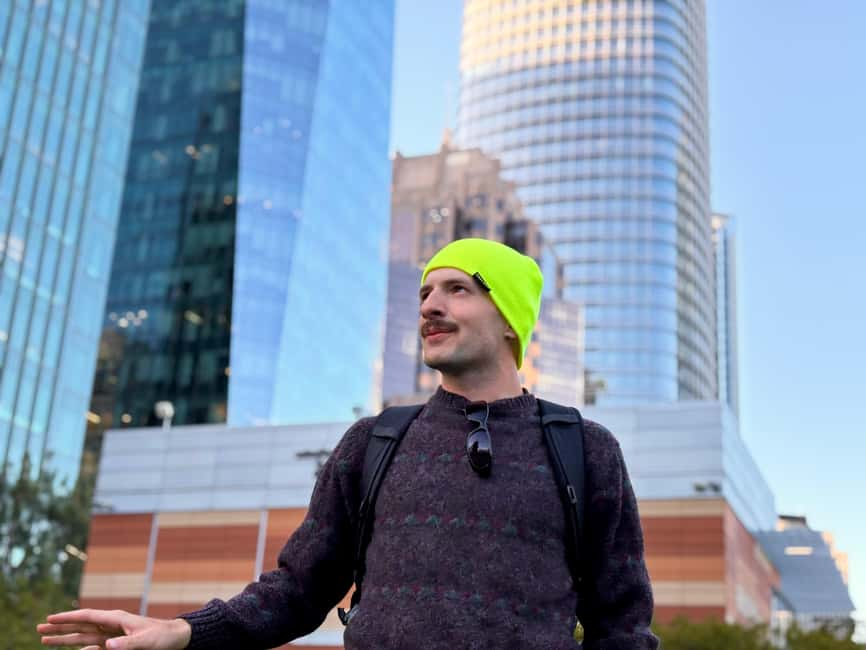
Guide Wes brings a useful perspective because he lives and works in the neighborhood and works with startups. That means he can explain both the local history and the technology industry’s role in the present-day district. His approach includes historical photographs, personal observations, and discussion of urban development.
The tone is meant to be lively rather than academic. You get names, dates, and changes in the built environment, but the guide also helps you connect those facts to the streets under your feet.
More History Tours in the USA:
- 2 Hour Historic Market Food Tour and Hands-On Biscuit Class
★ 5.0 · 251 reviews - 2-Hour Food, History and Street Art Tour of Ponce City Market
★ 5.0 · 159 reviews - Philadelphia Historic Centre Food Tour with 5 Authentic Tastings
★ 5.0 · 117 reviews
South Park: from garden square to startup address
The meeting point is in South Park, at 162 South Park Street. Spend 10 to 15 minutes here before the group heads north toward 2nd Street.
South Park was designed in the 1850s in the style of a British garden square. Its compact oval shape and green center feel very different from the hard-edged office blocks around it. The park has seating and shade, so it is a comfortable place to begin and get oriented.
Its importance comes from the number of different communities and uses that passed through it. During the Gold Rush, the area held an encampment. Later, it became a luxury development during the Gilded Age, then a refugee camp after the 1906 earthquake. It was also linked with San Francisco’s Japanese community and an industrial population.
In the 2010s, the same small park became closely tied to the startup world. The first offices of Instagram and Twitter were in the South Park area. Today, the surrounding district is part of San Francisco’s financial and technology center.
I find this opening especially effective because the park is small enough to understand at a glance. You are not just hearing that the neighborhood changed. You can stand in one place and imagine several different versions of the city occupying the same block.
The drawback is that the park itself is not a major sightseeing attraction in the usual sense. If you expect a grand monument, you may find it modest. Its value comes from the story and the location, not from a long list of physical sights.
2nd Street and the making of a commercial corridor
From South Park, the tour continues on foot along 2nd Street. This is one of the most historically important streets in the district because it linked downtown with the docks of the Pacific Mail Steamship Company.
That connection helps explain why this part of San Francisco developed as a working commercial area. Goods, people, and business moved between the city center and the waterfront. The street also reflects one of the city’s major early engineering projects: a large hill was flattened and the land was reclaimed to create room for a commercial thoroughfare.
This is a useful reminder that San Francisco is not only a city of steep hills. SoMa is the flattest part of the city, and this route takes advantage of that. You will walk rather than climb, though comfortable shoes still matter.
The modern business names here are just as striking as the older shipping story. 2nd Street is now associated with LinkedIn, DoorDash, and Anthropic. Earlier parts of the walk connect the area to Instagram and Twitter. Those names help you see how quickly the district’s role has shifted from port access and industry to software, online services, and startup offices.
I like this section because it avoids treating technology as a separate world from city history. The same street that once served maritime commerce now supports companies shaping digital life. The land is doing similar work, moving people, money, and ideas, even though the tools have changed.
The route is mostly flat, but the city setting can make it feel busy and visually dense. If you want a quiet nature walk, this is not the right choice. If you want to understand how streets function as economic corridors, it is a strong stop.
Folsom Street and the human side of redevelopment
The walk includes Folsom Street, a place known for its gay history. This adds an important social layer to the tour. SoMa is not only a story of buildings, companies, and investment. It is also a place shaped by communities that created their own identity and public life.
The information provided for the tour does not set out a long stop-by-stop account of Folsom Street, so you should think of it as part of the wider route rather than a separate attraction with a scheduled visit. Its inclusion helps place technology and redevelopment alongside the neighborhood’s cultural history.
That balance matters. A tour focused only on new office towers could make SoMa seem like an empty platform waiting for the next company. The older stories show that people already lived, worked, organized, and built communities here.
A few more market tours around the USA worth a look
- Chef Guided Food Tour of Pike Place Market
★ 5.0 · 3,733 reviews - Pike Place Market Tasting Tour
★ 5.0 · 1,696 reviews - Early-Bird Tasting Tour of Pike Place Market
★ 5.0 · 1,154 reviews - Center City Philadelphia Food Tour with Reading Market
★ 5.0 · 861 reviews
Yerba Buena Gardens and the price of urban renewal
Yerba Buena Gardens is the tour’s main stop for urban renewal. You will spend about 15 minutes here with the guide.
The gardens occupy the site of one of San Francisco’s largest urban renewal projects. The polished public space and surrounding development are easy to admire, but the tour asks you to consider who lived there before the project and what happened when they were forced out.
This is one of the most valuable parts of the experience. Urban renewal is often presented as a simple improvement story: replace aging buildings, add parks, attract investment, and create a new center. The human cost can disappear from that version. Here, you discuss the residents who were evicted and the effect that displacement had on San Francisco’s political climate.
You should not expect a full history of every household or every political debate in 15 minutes. The stop works more as a clear introduction to the issue. It gives you a way to look at Yerba Buena Gardens with more questions in mind.
I appreciate that the tour does not treat public space as automatically positive. A garden can be attractive and useful while still being connected to contested decisions about housing and power. That is a more honest way to understand city building.
The gardens also provide a change of pace during the walk. After the streets and office buildings, the open space gives you room to pause. If you have limited mobility, the flat route and accessible design of the tour are helpful, though the experience remains a walking tour and you should still wear supportive shoes.
Salesforce Park and the view from above
The final stop is Salesforce Park, the rooftop garden at Salesforce Terminal near Salesforce Tower. The tour spends about 15 minutes here before ending.
This is the most visible physical mark of the modern technology industry in San Francisco. The project is also the city’s largest development in recent history, so it gives the guide a natural place to discuss how much money, office space, and civic ambition have moved into SoMa.
The rooftop setting gives you a different view of downtown and the Bay. After learning how streets and blocks changed at ground level, you can look out across the city and see the scale of the newer construction.
The site has older layers too. The development was built over a beachfront natural gas refinery and was once associated with Tar Flat, described as the city’s poorest neighborhood. That contrast is central to the tour: a highly polished public garden now sits above a place connected with poverty, industry, and the waterfront edge.
You also have the opportunity to see Klockar’s blacksmith. It recalls the district’s earlier role as a center for metalworking and helps keep the industrial past visible at the end of a tour otherwise dominated by technology and redevelopment.
Salesforce Park is a strong finish because it ties together the route’s main subjects. You have seen the startup center at South Park, the shipping corridor on 2nd Street, the consequences of redevelopment at Yerba Buena Gardens, and the newest development above the old waterfront. The rooftop view lets you consider all those layers at once.
One practical point: this is a short visit, not a long afternoon in the park. The stop is designed for a guided look, a view, and a final discussion before you leave.
What the $30 price gives you
At $30 per person, the tour sits in the lower-cost range for a private or small guided city experience, though the exact group setup can vary because private groups are available. You are paying mainly for interpretation, not admission to a ticketed attraction.
That distinction matters. You could walk through South Park, 2nd Street, Yerba Buena Gardens, and Salesforce Park on your own. The value comes from understanding what you are seeing and how the sites connect.
A well-planned route can save you from treating SoMa as a collection of disconnected office buildings. Wes’s startup experience adds context that a general city guide may not provide, while his use of historical photographs helps you compare earlier versions of the neighborhood with what is in front of you.
The price is easiest to justify if you care about urban history, technology, architecture, politics, or San Francisco’s changing neighborhoods. It is less compelling if you only want famous landmarks or a long list of photo stops.
The tour’s perfect five-star rating from seven posted bookings points to a clear strength: the guide’s information, energy, and personal connection to the district. Several comments specifically praise Wes for explaining startup culture from the inside while also covering older eras of SoMa. One local participant had lived in San Francisco and still learned new material, which suggests the tour has value beyond a basic introduction.
Still, a small set of ratings cannot promise that every group will have the same experience. The tour depends heavily on the guide’s storytelling, and the short duration means some subjects will be covered briskly.
Timing, access, and where the walk ends
The tour lasts 70 minutes and is offered in English with a live guide. The starting point may vary according to the option you book, so confirm the exact meeting place before setting out. One listed starting point is 162 South Park Street.
You should bring comfortable shoes and comfortable clothes. The walk is mostly flat, and South of Market is San Francisco’s flattest neighborhood. The activity is wheelchair-accessible, which makes it a practical choice for many people who want a city walk without San Francisco’s usual steep grades.
The route ends at Salesforce Tower, near Salesforce Terminal and Salesforce Park. From there, you have easy access to BART and MUNI. Powell Street cable car is about a 15-minute walk away, so the tour can fit neatly into a day that continues toward Union Square or other downtown areas.
Free cancellation is available up to 24 hours before the start time, and you can reserve with payment later. Those terms are useful if your San Francisco schedule may shift, though the main decision should be whether the subject matter suits you.
Who should book this SoMa walk
I would choose this tour if you want to understand the city beyond its postcard sights. It suits visitors who are curious about how technology companies affect streets, jobs, public space, and housing. It also works well for locals who know downtown but have never connected its older industrial past with its current business identity.
The tour is a good match for:
- People interested in startups and the history of San Francisco’s technology industry
- Anyone curious about urban planning, redevelopment, and displacement
- Visitors who prefer a flat route
- First-time visitors who want a different side of downtown
- Locals looking for a new way to read familiar streets
- Private groups wanting a guided walk in English
You may want something else if you prefer grand historic buildings, long museum visits, or a broad survey of all San Francisco. This experience concentrates on one district and moves at a steady pace. It is about connections and context, not checking off a long list of sights.
Should you book the San Francisco Technology and History Tour?
Book it if you want the story behind the office towers. For $30, you get a focused walk through one of San Francisco’s most revealing districts, with clear links between startup culture, shipping, industry, public space, and displacement.
The best reason to go is Wes’s mix of local experience and startup knowledge. The strongest stops are South Park, where the city’s old and new identities meet, Yerba Buena Gardens, where redevelopment has a human cost, and Salesforce Park, where the modern tech city rises above earlier layers of SoMa.
Skip it if you want a relaxed sightseeing stroll with little discussion. But if you like asking who built a neighborhood, who benefited, and what came before, this short tour offers a useful and unusually grounded look at San Francisco.
FAQ
How long is the tour?
The walking tour lasts 70 minutes.
Where does the tour begin?
The listed starting point is 162 South Park Street, though the meeting point may vary depending on the option booked.
Where does the tour finish?
The tour ends at Salesforce Tower, near Salesforce Terminal and Salesforce Park.
Is the route wheelchair-accessible?
Yes. The tour is wheelchair-accessible, and South of Market is the flattest neighborhood in San Francisco.
What language is the tour in?
The live guided tour is in English.
What places does the route include?
The route includes South Park, 2nd Street, Folsom Street, Yerba Buena Gardens, and Salesforce Park.
What should I bring?
Bring comfortable shoes and comfortable clothes.
Can I reach public transit after the tour?
Yes. The finish is near BART and MUNI lines. The Powell Street cable car is about a 15-minute walk away.
Can I cancel the booking?
You can cancel up to 24 hours in advance for a full refund. Reserve now and pay later is also available.
Just added around the USA
- Charleston International Sweet Treats & Historic City Market Tour★ 5.0 · 22 reviews
- Boston City Day Trip to Harvard University, MIT and Quincy Market★ 3.0 · 2 reviews
- Devour Boston: North End Guided Food Tour & Market Visit★ 5.0 · 101 reviews
- Private Atlanta Sightseeing Tour w/ Shopping and Lunch Stop at Ponce City Market★ 5.0 · 3 reviews
- 4-hour Atlanta City Tour w/Ponce City Market Lunch Stop★ 4.5 · 8 reviews
- Insider’s Breakfast and Culture Tour of Pike Place Market★ 5.0 · 6 reviews
- South Philly Tour: Market, Cheesesteaks & Hidden Gems★ 5.0 · 2 reviews
- Secret Food Tours: Seattle Pike Place Market★ 5.0 · 3 reviews
Historical Tours, compared.
Private Excursion to Floating Market and Ayutthaya World Heritage
Read our review →
Discover Palermo in 3 hours. Art, history, markets and street food
Read our review →
Private Heritage Walking Tour in Jaisalmer Fort and Old Bazaar
Read our review →
2 Hour Historic Market Food Tour and Hands-On Biscuit Class
Read our review →
Abu Dhabi Sightseeing Tour: Sheikh Zayed Mosque, Heritage Village & Dates Market
Read our review →
Historic Center Street Food, Market, and Eateries Tour
Read our review →
Old Delhi: Spices, Heritage and Bazaars Walking Tour
Read our review →Browse the lists this tour appears in