
Review · TANGIER MARKET TOURS
Walking Tangier Tour from ancient Kasba to Bustling Souks
Tangier’s best story unfolds on foot, from the broad sweep of Grand Socco into the narrow lanes of the old medina. This private tour links six important places, including the former sultan’s palace, a world-changing diplomatic site, and a restored 19th-century synagogue.
I like the private format, which lets your guide adjust the pace and follow your interests. I also like the mix of famous sights and less expected stops, especially the American Legation and Moshe Nahon Synagogue. The main drawback is that the advertised two to four hours can feel tight if you want long museum visits and plenty of time in the souks.
Key points to know before booking
- Six central stops: Walk from Grand Socco through the Kasbah and medina, with museum visits along the way.
- Private attention: Only your group participates, so guides can focus on your interests and adjust the pace.
- Strong local guiding: Anas, Bilal, and Rabab are named guides associated with the experience, each praised for warmth, care, and personal attention.
- More than a market walk: The route covers Phoenician trade, Andalusian design, American diplomacy, Jewish heritage, and daily life.
- Good for a short stay: The route gathers several major Tangier sights into a two to four hour walk.
- Plan for a compact schedule: The six listed visits add up to about 175 minutes before moving between them.
Why this Tangier walk works so well
Tangier can feel confusing at first. The modern city, old medina, port connections, French and Spanish influences, and maze-like lanes all meet in a relatively small area. This tour gives you a local guide to connect those pieces instead of leaving you to decode them alone.
The route begins at Place du Grand 9 Avril 1947, better known as Grand Socco. From there, you move toward the Kasbah, the old city, and several museums. That order makes sense: you begin where modern Tangier meets the old town, then work uphill and inward toward the city’s oldest quarters.
I especially like the way the tour combines broad historical themes with ordinary street scenes. You get architecture and museum displays, but you also pass through markets and lanes where Tangier functions as a living city rather than a preserved exhibit.
The tour costs $48.50 per person. For a private experience with several admissions included, that can be good value, especially if you are visiting Tangier for only a day or have limited time. A solo visitor pays more per person than someone booking with a small group, but the private format gives you room to ask questions and shape the visit.
The guides named in the available feedback include Anas, Bilal, and Rabab. Anas is praised for making the visit informative and entertaining, Bilal for his professional manner and clear explanations, and Rabab for adapting the route to a visitor interested in maps and architecture. Those details matter because this tour depends heavily on the guide. The places are worthwhile, but the connections between them are what make the walk memorable.
A few more market tours around Morocco worth a look
- Marrakech: Bahia Palace, Saadian Tombs, Souk and Medina Tour
★ 4.7 · 4,974 reviews - Marrakech: Ben Youssef, Secret Garden, & Souks Walking Tour
★ 4.6 · 2,802 reviews - Marrakech: Colorful Medina Souks Guided Walking Tour
★ 4.7 · 2,470 reviews
Grand Socco: Tangier’s meeting point
The tour opens at Grand Socco, a large public square that links the old medina with the newer city. The name comes from souk, the Arabic word for market, and the square has long been a place for trade and public life.
Allow about 15 minutes here. That is enough to get your bearings, hear how Tangier grew around this meeting point, and watch the flow of people between the modern streets and the old town. The open space also gives you a useful contrast before you enter the tighter lanes of the Kasbah.
The square mixes traditional forms with colonial-era architecture. It is not just a photo stop. It helps explain Tangier’s position between different worlds, with local commerce, foreign influence, and movement through the city all visible in one place.
Because the visit is short, I would not expect a long architectural study here. Think of Grand Socco as the opening chapter. Your guide can place the rest of the walk in context before the route becomes more focused on historic buildings and museum collections.
The Kasbah: walls, lanes, and high views
From Grand Socco, the route continues into Tangier’s Kasbah. Perched at the city’s highest point, this old fortress area has narrow streets, defensive walls, and a layout shaped by its military purpose.
The planned time is about 45 minutes, making this one of the longer outdoor sections. You will have time to notice the turns and changes in the streets rather than simply crossing the area on the way to a museum.
The Kasbah reflects several layers of Tangier’s past. Phoenician and Roman influences sit alongside Arab and Andalusian contributions, producing architecture that does not fit into a single category. Your guide’s explanations are especially useful here because much of the story is built into walls, doorways, street patterns, and views rather than displayed on signs.
I like this part for its sense of place. The Kasbah is not a single monument with a neat entrance and exit. It is a neighborhood, and the narrow lanes make the city feel close and human. You may also find the walking more demanding than the opening stop because of the uphill setting and uneven old-city streets. Comfortable shoes are a sensible choice.
Dar El Makhzen and the Kasbah Museum
The Kasbah Museum occupies Dar El Makhzen, the former palace of the sultan. The museum traces the area from prehistoric times through the 19th century, giving you a useful timeline after seeing the old city in person.
The visit lasts about 35 minutes. You begin in the first courtyard, work around it in an anticlockwise direction, then continue indoors before reaching the Andalusian garden. The building itself is part of the attraction. You are not just moving through display rooms, but through a former royal setting with courtyards and decorated spaces.
Several pieces deserve special attention. The Roman mosaic of Venus from Volubilis is a major highlight, and the statuary adds physical detail to the historical story. The large replica maps are particularly unusual. One traces trade routes from Phoenician metal trading through modern electronic goods. Another presents the known world as mapped in Tangier in 1154, with the map oriented upside down by modern expectations.
The displays are in French and Arabic only. That is an important practical point. If you do not read either language, the guide becomes more valuable because you can ask for explanations instead of relying on labels. The 35-minute schedule gives you an overview, not time for a slow museum study.
Same place, a different set of stalls:
- Marrakech: Traditional Moroccan Cooking Class & Market Visit
★ 4.8 · 1,861 reviews - Marrakech Monuments & Souks 3-Hour Tour
★ 3.8 · 1,540 reviews - Moroccan Cooking Class & Marrakech Market Visit with Chef Khmisa
★ 5.0 · 1,504 reviews - Marrakech: Saadian Tombs, Bahia Palace, Medina and Souk Tour
★ 4.7 · 673 reviews
Tangier’s medina and its maze of daily life
The medina is the most atmospheric walking section. Its narrow alleys, old walls, shops, spices, colors, and hidden courtyards create a sharp change from the open space of Grand Socco.
The route allows about 35 minutes here. That is enough for an introduction to the old city and its street life, but it is not a full afternoon of browsing. If you enjoy shopping, food, or photography, you may want to tell your guide early so the walk can reflect those interests.
The medina has attracted artists and writers for generations, including the American writer William Burroughs, who famously referred to it as a kind of switchboard zone. You do not need to know that literary background to enjoy the place, but it helps explain why Tangier has drawn people looking for a city outside ordinary routines.
This section is also where local guidance can prevent frustration. The lanes can feel disorienting, and a private guide lets you focus on the surroundings rather than constantly checking directions. One especially useful detail from the available feedback is that the guide did not pressure visitors to buy things. That matters in a market setting. You can look, ask questions, and keep walking without feeling that every stop must become a purchase.
The American Legation: a small building with global importance
The Tangier American Legation Museum is one of the most distinctive stops on the route. The United States acquired the property in 1821, making it the oldest American diplomatic property in the world and the first property acquired abroad by the U.S. government.
The site also connects to the Moroccan-American Treaty of Friendship, signed in 1786. That treaty predates the U.S. Constitution and marks the early relationship between Morocco and the United States. A visit here adds international context to a city already shaped by contact between Europe, Africa, and the wider Mediterranean world.
You have about 30 minutes at the museum. That is a useful amount of time for a guided overview and a closer look at the building’s role. The stop feels different from the Kasbah Museum. Dar El Makhzen focuses on the long story of the region, while the American Legation concentrates on diplomacy, exchange, and the unusual place Tangier held in international affairs.
I would pay close attention to your guide’s explanation here. The building’s importance is not always obvious from its size or appearance. Its value lies in what it represents: a long-running relationship between Morocco and the United States, carried out in a city known for contact across borders.
Moshe Nahon Synagogue and Tangier’s Jewish heritage
The final listed stop is Moshe Nahon Synagogue, located on a dead-end street near Rue des Synagogues in the Beni Idir quarter of the medina. The synagogue was built in the 19th century by Moïse Nahon, an educator and scholar from a prominent Jewish family in Tangier.
It stopped functioning in the second half of the 20th century and later fell into disrepair. Restoration in 1994 returned the building to use as a museum. The stop lasts about 15 minutes, so expect a focused visit rather than an extended tour.
This is a valuable final note because it shows another part of Tangier’s past. The city’s identity is not only Arab, Andalusian, European, or American. Jewish families and institutions also shaped its neighborhoods and public life. The synagogue’s location inside the medina makes that point especially well.
The short visit may leave you wanting more time, but it also keeps the walk moving. If Jewish heritage is a main interest, tell the guide when booking or at the beginning. The private format may allow more attention to that subject, though the published schedule still limits the overall length.
How the private format changes the experience
Only your group takes part in the tour. That is the clearest advantage over a large shared walk. You can ask about architecture, maps, religion, literature, trade, or local customs without worrying about holding up a busload of people.
The guide can also respond to your pace. If your group includes children, older family members, or anyone who prefers shorter explanations, private guiding gives you a better chance of keeping the walk comfortable. The experience is also suited to visitors with only a few hours in Tangier because it places several central sights into one route.
The available guide names give you useful choices to keep in mind. Anas is associated with an engaging, entertaining approach. Bilal is described as professional and attentive. Rabab is noted for identifying a visitor’s interests and shaping the experience around maps and architecture. You cannot assume which guide you will receive unless the operator confirms it, but these examples show the kind of personal service the experience aims to provide.
Pickup is offered, a mobile ticket is available, and the meeting area is near public transportation. The listed operating window is Monday through Sunday from 10:00 a.m. to 1:00 p.m. Confirm the exact meeting details when booking, since the information provided gives the general window rather than a detailed pickup schedule.
Timing, walking effort, and overall value
The advertised duration is two to four hours. The six stops account for roughly 175 minutes before you add the walks between them, so the final length will depend on the pace, questions, and time spent moving through the medina.
That range is helpful but also slightly broad. A brisk two-hour version would give you a strong introduction, while a longer visit would better suit anyone who wants museum explanations and time to look around. If you have a ferry, train, or other fixed departure, allow extra time beyond the stated tour duration.
At $48.50 per person, the price is easiest to justify if you value private guiding and want admissions handled as part of the route. You are paying for local interpretation, navigation through the old city, and a carefully connected group of places, not simply for a walk through market lanes.
The value is less clear if you want a slow, independent shopping trip or long museum visits. In that case, a self-guided day may give you more freedom, though it will not provide the same help with context and navigation.
The operator has a five-star rating based on 70 reviews and a 100 percent recommendation figure. Those numbers suggest a strong service record, but the practical takeaway is more useful: the best parts of this tour are the guides’ care, local connection, and ability to tailor the conversation.
Who should book this Tangier experience
I would recommend it to first-time visitors who want a clear introduction to the old city without sorting out the route alone. It also suits families, people with limited time, and anyone interested in history beyond the usual market walk.
Culture lovers will appreciate the mix of palace architecture, Roman artifacts, medieval maps, American diplomacy, and Jewish heritage. Visitors drawn to design may want to ask for extra attention to Andalusian details, maps, doorways, and the Kasbah’s street plan.
You should think twice if you dislike walking in narrow old-city lanes or prefer a slow day with no fixed sequence. The tour covers a lot, and the schedule may feel full. It is also not the best fit for someone who wants extensive shopping time, since the medina section is only about 35 minutes.
Free cancellation is available up to 24 hours before the start time. Cancellations made less than 24 hours ahead are not refunded, and late changes are not accepted.
Should you book the Walking Tangier Tour?
Book it if you want Tangier explained by a local guide, with the Kasbah, medina, three museums, and a synagogue gathered into one private walk. The strongest reason to choose it is the combination of personal attention and historical range.
I would book early, especially since it is commonly reserved well ahead of the date. At $48.50, it offers solid value for a private introduction, provided you are comfortable with a fairly active schedule. Ask for a slower pace if you want more time at the museums, and tell the guide what interests you most.
Skip it if your priority is an unstructured shopping afternoon or a long, detailed museum visit. For nearly everyone else with a few hours in Tangier, this is a smart way to get oriented and see how the city’s many communities and eras fit together.
FAQ
How long does the Walking Tangier Tour last?
The tour lasts approximately two to four hours. The exact length can depend on walking pace, questions, and time spent at each stop.
What places are included?
The route includes Grand Socco, Tangier Casbah, Musee de la Kasbah, the Medina of Tangier, Tangier American Legation Museum, and Moshe Nahon Synagogue.
Is this a private tour?
Yes. Only your group participates in the activity.
Is pickup available?
Yes. Pickup is offered, and the meeting area is near public transportation.
What are the tour’s operating hours?
The listed opening hours are Monday through Sunday from 10:00 a.m. to 1:00 p.m., for the period from December 1, 2024, through June 17, 2026.
Are museum admissions included?
Admission tickets are included for each listed stop.
What is the cancellation policy?
You can cancel at least 24 hours before the start time for a full refund. Cancellations or changes made less than 24 hours before the start time are not accepted for a refund.
Just added around Morocco
- Moroccan Cooking Class with a Local Family & Market Visit★ 5.0 · 16 reviews
- Private Market Tour & Cooking Class in Casablanca with Transfers★ 5.0 · 20 reviews
- Casablanca Market and Street Food Walking Tour★ 5.0 · 3 reviews
- Market Tour & Moroccan Cooking Class in Casablanca with Transfers★ 5.0 · 18 reviews
- 5 am in Casablanca: Mosque, Medina, Beach , Souks , Coffee and more★ 5.0 · 11 reviews
- Agadir city Tour with big Souk Elhad★ 5.0 · 5 reviews
- High Atlas Mountains And The Local old Market Private Day Tour★ 3.5 · 5 reviews
- Paradise Valley & Gorge Adventure with Souk & Transfer★ 4.0 · 5 reviews
Tangier Market Tours, compared.
3h Private Walking Tour in Tangier Kasbah Medina & Colorful Souks
Read our review →
Tangier Private Tour :Medina ,souks, kasbah, caves & camel ride
Read our review →
Tangier Food Tour with a foodie guide, Medina & Souks!
Read our review →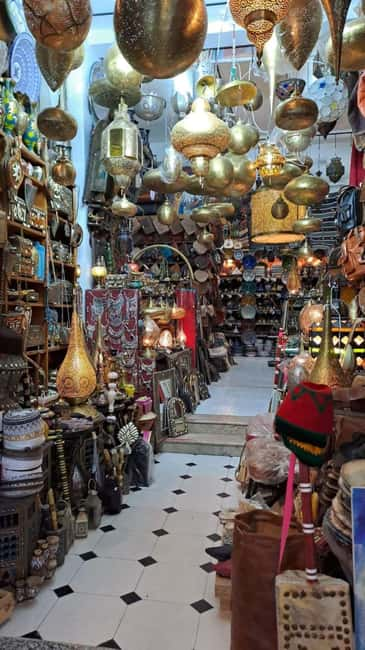
Browse the lists this tour appears in