
Review · FLOWER & FLEA MARKET TOURS
Morning Buddhist Almsgiving, Grand Palace and Flower Market Tour in Bangkok
Bangkok is at its most striking before breakfast, when orange-robed monks move quietly through streets that have not yet filled with traffic. This five-hour tour pairs that early Buddhist ritual with Pak Khlong Talat flower market and the Grand Palace, giving you three very different views of the city in one morning.
I like the small maximum of eight people, which should make it easier to ask questions and follow the guide through busy royal grounds. I also like that food for the monks, hotel transport, bottled water, and cold towels are included, so you do not need to arrange the morning piece by piece.
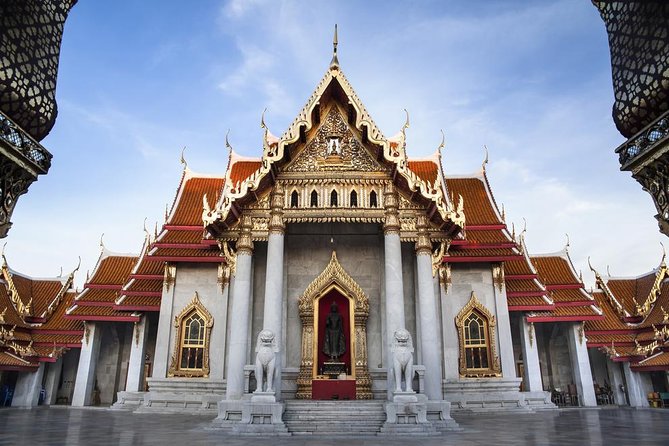
The main caution is the timing. Almsgiving may be brief and street-level, and the Grand Palace opens later, leaving a possible gap after the early ceremony. The precise almsgiving location can also change, with Wat Benchamabophit, the Marble Temple, listed as the likely stop rather than a guarantee.
Key points to know before booking
- The morning begins at 6:30 am: Hotel pickup gets you moving before Bangkok becomes crowded.
- The almsgiving is participatory: Food for the monks is included, while extra offerings cost more.
- The Marble Temple may be the first stop: The guide chooses the location, and an alternate site is possible.
- The flower market gives you about an hour: Pak Khlong Talat is the largest wholesale and retail flower market in Bangkok.
- The Grand Palace visit covers major royal and religious sites: Expect Wat Phra Kaew, the Emerald Buddha, the Royal Funeral Hall, and the Royal Coronation Hall.
- The group is capped at eight: That is useful for a morning focused on religious customs and detailed questions.
A dawn start with a real Bangkok ritual
The day begins with pickup from a Bangkok city hotel at about 6:30 am. You ride in a comfortable bus to the almsgiving location, most likely Wat Benchamabophit, commonly called the Marble Temple. The temple is known for its decorated gables and detailed design, so even a short visit gives you an impressive architectural setting.
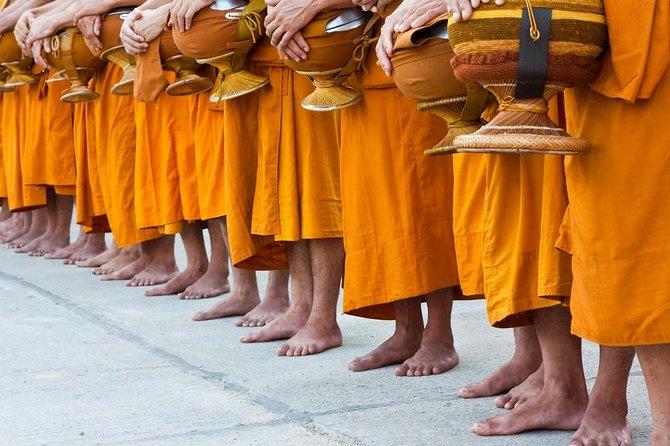
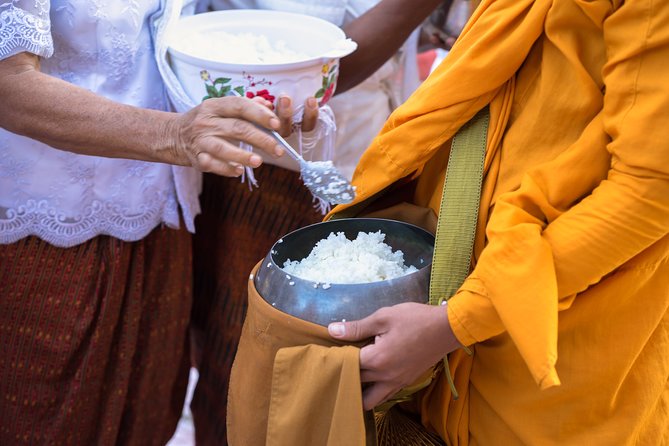
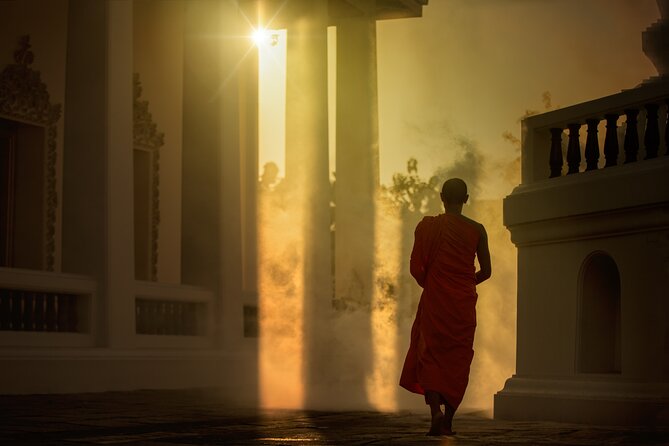
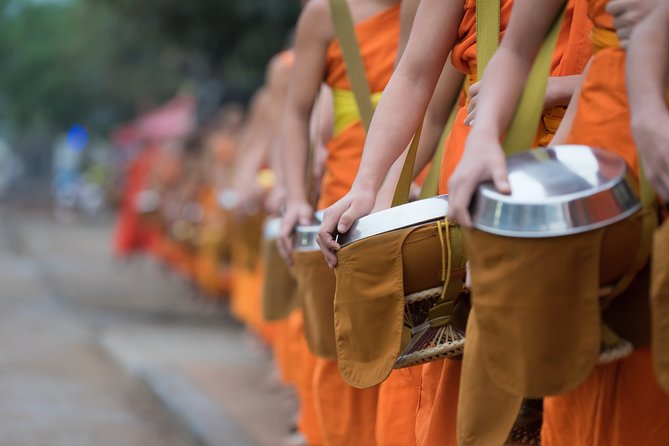
The ceremony itself is simple. Local people offer food to monks who live and study at nearby monasteries. Monks pass in silence wearing orange robes, while the city slowly wakes around them. Your guide explains how to approach the monks and what kinds of food are appropriate.
Food for the monks is included in the tour price. If you want to make further offerings, you pay for those yourself. That distinction matters because vendors may offer fish, food, or other items near the ceremony, and you should not feel pressured to buy more than you planned.
I would set your expectations carefully. This is not guaranteed to be a long, private religious service inside a quiet temple hall. The ceremony may take place at street level, and the offering itself can be short. One account described only a few minutes at the actual almsgiving after a long ride, while another found the setting less solemn than expected because vendors approached people nearby.
That does not make the ritual false or meaningless. It means you are seeing a daily practice as it happens in ordinary city life, with commerce and traffic close by. If you want a polished cultural demonstration, this may feel rough around the edges. If you want to see how Buddhist giving functions in Bangkok beyond a staged temple presentation, the street setting has value.
More Flower and Flea Market Tours in Bangkok
- Bangkok: Night Bike Tour with Temples & Flower Market Visit
★ 4.8 · 751 reviews - Bangkok: Night Bike Tour with Temples & Flower Market Visit
★ 5.0 · 223 reviews - Flower Market & Floral Art: Multilingual Private Tour [EN/others]
★ 4.5 · 33 reviews
Why the small group matters here
The group limit is eight people, with at least four required for the booking to operate. This is a useful size for a ritual where timing, manners, and local customs need explanation. You should be able to hear the guide and ask how to stand, what to offer, and when to step forward without being lost in a large crowd.
The guide is central to the quality of this morning. The strongest part of the experience is the explanation of Buddhist almsgiving, including how the tradition supports monks in meditation and study. The guide also connects the ritual to present-day Bangkok, rather than treating it as a colorful photo stop.
The quality of guiding can vary. Some past feedback found the explanations clear and thoughtful, while other comments found the guide less informed than expected. One account also described a guide reading email, taking photographs, and buying food during the tour. That is not the attentive service you should expect from a premium small-group experience, so the guide’s performance is an important unknown.
There are no guide names provided for this experience. If you book, ask the operator to confirm the pickup details and the expected first stop before the morning begins.
Pak Khlong Talat: one hour among Bangkok’s flowers
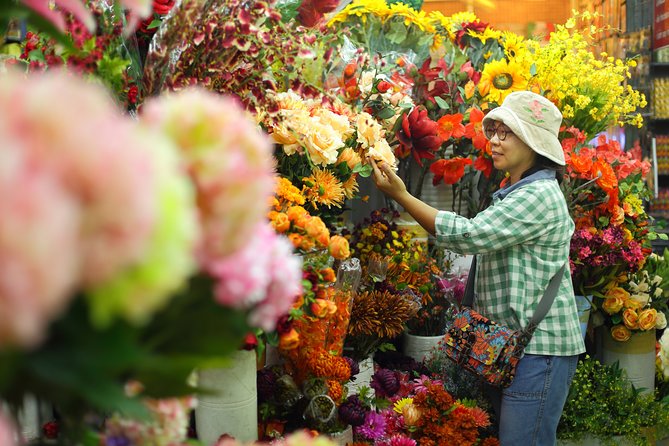
After almsgiving, the tour heads to Pak Khlong Talat, Bangkok’s largest wholesale and retail flower market. You get about an hour to walk among stalls filled with orchids, roses, and other flowers from across Thailand.
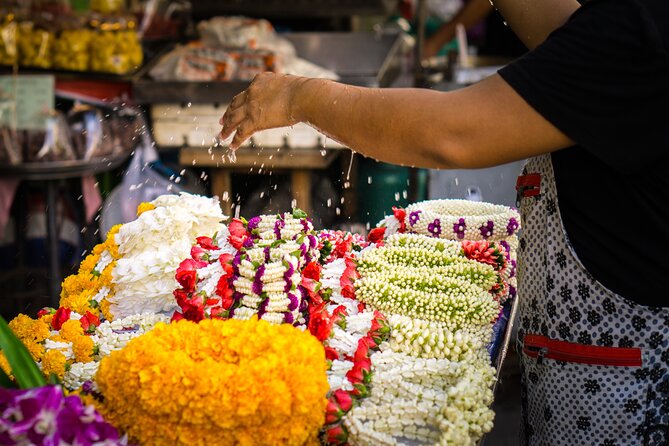
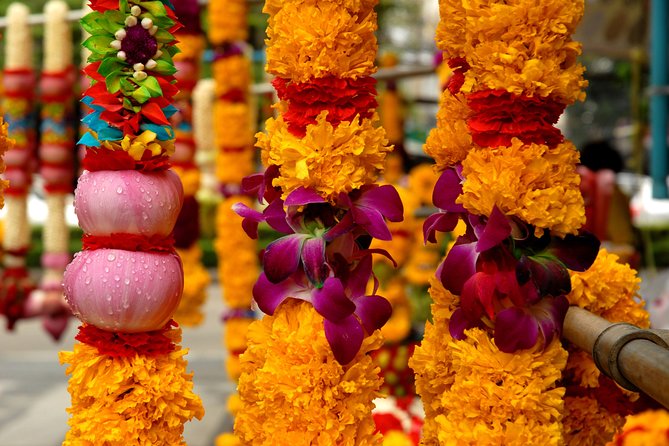
This is a good contrast to the quiet start. Instead of watching one ritual unfold, you can move at your own pace and take in the market’s colors, scents, and working rhythm. The market is not simply a display for tourists. Flowers are sold in large quantities for homes, temples, ceremonies, and daily use, giving you a look at a practical part of Bangkok’s trade.
You can buy a snack here at your own expense. Food and drinks are not included unless specifically stated, although bottled water and cold towels are provided. I would carry some Thai baht if you want to buy a small item, but the tour does not promise shopping time beyond the market visit.
The allotted hour is enough to see the main displays without turning the stop into a long shopping session. It also gives the guide time to point out different flowers and explain how the market operates. If flowers are not a major interest, this stop still works as a change of pace before the more formal palace visit.
The order described for the morning is almsgiving, flower market, and then the Grand Palace. The stop list also gives separate time estimates for the palace sites and flower market, so the precise sequence and length can depend on traffic, opening times, and the guide’s decisions.
Entering Wat Phra Kaew and the Grand Palace
The Grand Palace is the morning’s major sightseeing stop. Once the royal home of the kings of Siam, it remains important for official ceremonies. Your visit includes the palace grounds and Wat Phra Kaew, the Temple of the Emerald Buddha.
Wat Phra Kaew houses Thailand’s most revered religious image, the Emerald Buddha. Despite its name, the statue is carved from one piece of jade rather than emerald. Its small size can surprise you, especially after seeing photographs that give it a larger presence, but its religious importance is immense.
The guide explains why the statue is considered the holiest object in Thailand. This context is valuable because the temple is filled with intricate decoration, gold details, and formal religious customs that can otherwise blur together. You are not simply walking through a beautiful complex. You are learning why the site carries such weight for the country.
The tour schedule allocates about 45 minutes to Wat Phra Kaew and another 45 minutes to the Grand Palace and upper terrace areas. The description also refers to a half-hour guided palace tour and a 1.5-hour guided look at the wider complex. In practical terms, you should expect a focused visit rather than a leisurely half-day examination of every building.
The Royal Funeral Hall and Royal Coronation Hall are included. These add royal ceremony and state tradition to the religious focus of Wat Phra Kaew. The upper terrace also shows the unusual mix of traditional Thai architecture and European design found within the complex.
The Grand Palace can be demanding because it is large, ornate, and subject to strict entry rules. Your guide’s explanations are especially useful here, but you should not expect every room or building to be open for extended inspection. The palace is still used for ceremonies, and access can be shaped by official activity.
Same place, a different set of stalls:
- Bangkok: Damnoen Saduak Market and Maeklong Railway Market
★ 4.5 · 26,723 reviews - The Old Siam: Damnoen Saduak and Maeklong Railway Market
★ 4.5 · 10,992 reviews - Bangkok: Train Market & Floating Market with Boat Ride
★ 4.7 · 9,547 reviews - Bangkok: City Highlights Temple and Market Walking Tour
★ 4.5 · 3,990 reviews
Dress correctly or risk losing valuable time
The dress code is strict. Men need long pants and a shirt with sleeves. If you wear sandals or flip-flops, you must also wear socks, so bare feet are not acceptable. Women need modest clothing with covered shoulders and no see-through fabric.
Avoid bright colors if possible. The instructions specifically recommend more subdued clothing, so loose, respectful clothes in neutral or muted shades are a sensible choice.
Do not leave this decision until pickup time. A clothing problem can delay entry or force you to buy or borrow something suitable. Wear long trousers or a long skirt, covered shoulders, and comfortable footwear from the start.
This is not the morning for beachwear, short shorts, or a sleeveless top. The almsgiving may be informal, but the Grand Palace and Wat Phra Kaew set the clothing standard for the entire tour.
The timing problem and what it means for value
The tour lasts about five hours and should finish around 11:30 am, returning you to your Bangkok hotel. The early start is sensible for almsgiving, but it creates a scheduling problem because the Grand Palace opens later.
One past account described finishing the almsgiving around 7:00 am and having nothing planned until about 8:45 am. That gap can feel wasteful, especially when you have been collected before sunrise. The operator may use traffic conditions, the flower market, or another site to manage the timing, but you should be prepared for some waiting.
This matters because the price is $106.33 per person. You are paying for hotel pickup and drop-off, transport by comfortable bus, a small group, food for the monks, admission to Wat Phra Kaew, a local guide, bottled water, and cold towels. For someone who wants a tightly arranged morning without handling Bangkok transport, that bundle can be worthwhile.
The value is weaker if you mainly want the Grand Palace. You could spend less by visiting the palace independently and arranging your own transportation, though you would lose the almsgiving explanation and the included monk offering. The package earns its price through the combination of experiences, not through the palace visit alone.
The tour is booked an average of 109 days ahead, which suggests that you should not treat it as a last-minute choice if your Bangkok schedule is fixed. It requires at least four people to operate, and if the minimum is not met, you are offered another date or experience, or a full refund.
Who will enjoy this morning most
I would recommend this tour to you if you want cultural context along with Bangkok’s famous sights. It suits first-time visitors who want to see the Emerald Buddha but also want a local explanation of Buddhist giving, royal ceremony, and the flower trade.
It is also a good fit if you prefer a small group. Eight people is far more manageable than a large coach party when you are moving through Wat Phra Kaew, asking questions, or learning how to participate respectfully in almsgiving.
You should think twice if you dislike early starts, waiting, or changes in the plan. The first ceremony may be short, vendors may approach you, and the almsgiving location is not guaranteed. You may also find the palace visit rushed if you prefer to linger over architectural details.
The experience is less suitable if you need an accessible itinerary with a clearly stated mobility plan. The available information says most people can participate, but it does not provide detailed accessibility information for the bus, market, temple grounds, or palace.
Cancellation is free up to 24 hours before the local start time. Changes or cancellations made within 24 hours are not refunded, and late changes are not accepted.
Should you book the Buddhist almsgiving and palace tour?
Book it if you value an early Buddhist ritual, a flower market, and the Grand Palace in one organized morning. The best features are the small group, the included offering for monks, and the chance to learn the proper way to approach the ceremony rather than simply watching from a distance.
Do not book it expecting a long, silent, private almsgiving ceremony. The ritual may be brief and take place beside vendors and normal street activity. Also allow for a possible waiting period before the Grand Palace opens.
At $106.33, the tour is a fair convenience purchase for a visitor who wants transport, context, and several major sights handled in one booking. It is not the cheapest way to see the palace. For me, the decision comes down to the almsgiving: if that is the reason you are interested, the combination is worthwhile. If the Emerald Buddha is your only priority, visit the Grand Palace separately and spend the rest of the morning at your own pace.
FAQ
What time does the tour begin?
The stated start time is 6:30 am. Hotel pickup is offered from Bangkok city hotels.
How long does the experience last?
The tour lasts approximately five hours and is expected to finish around 11:30 am with return transport to your hotel.
Where does the almsgiving take place?
The guide selects the location. Wat Benchamabophit, also called the Marble Temple, is the likely site, but an alternate location is possible.
Is food for the monks included?
Yes. Food for the monks is included in the tour price. Any additional offerings are paid for separately.
Can I make extra offerings to the monks?
Yes, but extra offerings are at your own expense. You are not required to purchase additional offerings.
What is included at the flower market?
You receive about an hour to explore Pak Khlong Talat flower market. Snacks, food, and drinks are not included, although bottled water is provided.
Which palace sites are included?
The tour includes Wat Phra Kaew, the Emerald Buddha, the Grand Palace, the upper terrace, the Royal Funeral Hall, and the Royal Coronation Hall.
What should I wear?
Men must wear long pants and a shirt with sleeves. Women must dress modestly, with covered shoulders and no see-through clothing. Sandal or flip-flop wearers must have socks, and avoiding bright colors is recommended.
How many people can join the tour?
The maximum group size is eight people. A minimum of four people per booking is required.
Is hotel transportation included?
Yes. Hotel pickup and drop-off from Bangkok city hotels are included, along with transport by bus, bottled water, and cold towels.
Just added around Bangkok
- Bangkok Udomsuk Thai Cooking Class with local market tour★ 5.0 · 5 reviews
- Floating & Railway Markets and Erawan Waterfall [Optional Luxury]★ 5.0 · 43 reviews
- Floating Market & Railway Market near Bangkok★ 4.0 · 5 reviews
- Private 4 days : Bangkok, Floating market and Ayutthaya★ 5.0 · 2 reviews
- Silom Thai Cooking School with Fresh Market Tour★ 5.0 · 73 reviews
- Ayutthaya Floating Market Admission Ticket with Transfer★ 5.0 · 2 reviews
- Train & Floating Market Food Adventure + Scenic train ride★ 5.0 · 102 reviews
- Maeklong & Damnoen Saduak Markets: Railway & Floating Market Tour★ 4.0 · 17 reviews
Flower & Flea Market Tours, compared.
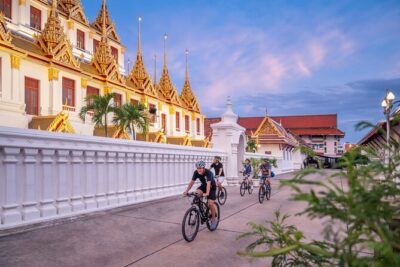
Night Bike Tour with Temples & Flower Market Visit
Read our review →Night Bike Tour with Temples & Flower Market Visit
Read our review →
Jaipur Tour by Tuk-Tuk or Car with Flower Market
Read our review →
Half-Day Guided Sightseeing Tour with Flower Market
Read our review →
Half or Full Day Sightseeing Tour with Flower Market
Read our review →
Browse the lists this tour appears in