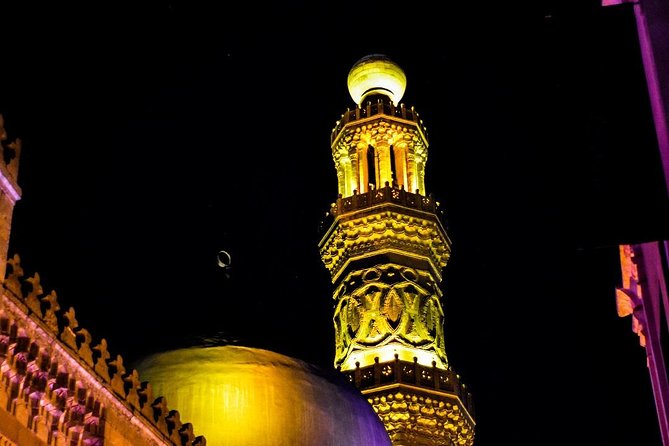
Review · GRAND BAZAAR & SPICE MARKET TOURS
Private Tour To Islamic Cairo and Khan El-Khalili Tourist Bazaar
Islamic Cairo is best understood on foot, where a medieval gate can lead to a mosque, a restored merchant house, and a crowded bazaar within a few minutes. This private tour gives you that close-up view while a chauffeur handles Cairo’s traffic before and after the walk. I especially like the chance to explore Muizz Street with a guide who can explain the buildings rather than leave you to guess at them.
I also like the flexible departure times and the private format. Guide Hamada is praised for adjusting the route to match personal interests, and the guide can help with photo angles as well as history. The main drawback is pace: several major sites are packed into four to six hours, so you may see many places without having time to study every one.
Key points at a glance
- Private transport from your hotel: Ride in an air-conditioned vehicle with Wi-Fi instead of sorting out Cairo traffic and public transport.
- Medieval Cairo on foot: Walk along Muizz Street, one of the city’s great historic streets, with admission included at the listed stops.
- Two surviving city gates: See Bab al-Futuh in the north and Bab Zuweila in the south, both tied to the walls of Fatimid Cairo.
- A serious architectural lineup: The route includes the Qalawun Complex, Bayt Al-Suhaymi, and the Sultan Al-Ghuri Complex.
- Khan El-Khalili and El Fishawi café: Finish among Cairo’s famous market lanes with a non-alcoholic drink in a traditional café.
- A useful private-guide advantage: Your guide can shape the walk around your interests, explain local customs, and help you handle the bazaar with less hassle.
Why this private Cairo walk works
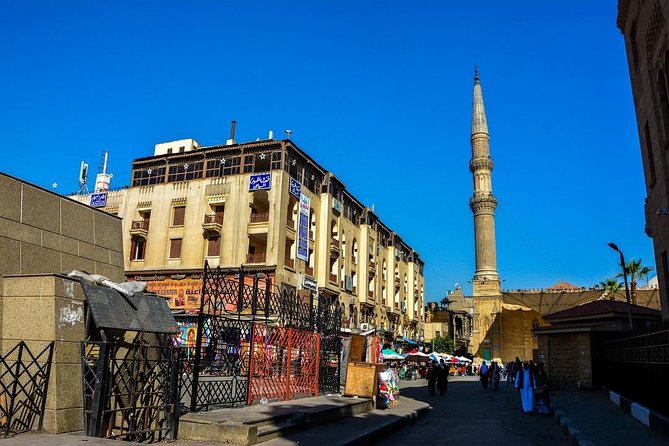
The appeal here is not simply checking off Islamic Cairo landmarks. It is the way the route links monuments, streets, gates, homes, markets, and everyday city life. Historic Cairo was recognized by UNESCO in 1979 for its major collection of mosques, religious schools, baths, fountains, mansions, caravanserais, tombs, and fortifications.
You get a short ride to the old city, then spend the heart of the tour walking. That matters because the historic core is best seen at street level. A vehicle can take you to a famous mosque, but it cannot show you how the buildings line up along Muizz Street or how an old gate frames the market beyond it.
A private guide also changes the tone. You are not tied to a large group’s questions, walking speed, or photo stops. If you care about architecture, your guide can focus on stonework and design. If you prefer stories about rulers and daily life, you can steer the conversation that way. Hamada is specifically noted for being flexible and for asking about interests before shaping the visit.
The tour is not designed for a slow, scholarly study of every building. With six main stops and transport, expect an efficient overview. I would choose it for a first look at Islamic Cairo, especially if you want help making sense of a dense district in a limited amount of time.
More Private Market Tours in Cairo
- Cairo 8 Hour Private Tour of Pyramids, Egyptian Museum and Bazaar
★ 5.0 · 2,931 reviews - Cairo: Private Pyramids, Museum & Bazaar Tour with Lunch
★ 4.6 · 744 reviews - Cairo: Local Markets & Khan el Khalili Private Shopping Tour
★ 4.6 · 614 reviews
Starting with the old city and Qalawun Complex
The first two hours are devoted to Islamic Cairo, the broad historic quarter around the old walled city and the Citadel area. This is the part of Cairo where the city’s Islamic-era buildings gather in remarkable numbers, often along streets that still function as living parts of the city.
The Qalawun Complex is one of the important architectural stops. Dating from the 13th century, it represents the scale and ambition of medieval Cairo’s religious and civic buildings. A guide adds real value here because the complex is not just a pretty façade. Its parts, decoration, religious purpose, and position along the old street all make more sense when someone explains how they fit together.
The route also includes Bayt Al-Suhaymi, a 16th-century boarding house and historic residence. This gives you a change of scale. Large religious complexes can feel formal and imposing, while a house or boarding building helps you picture how people lived, worked, and received visitors in the old city.
Admission is included at the listed stops, so you are not expected to keep paying at each major entrance. Still, I would confirm the exact sites open on your date, since historic buildings can have changing access.
Walking the one-kilometer length of Muizz Street
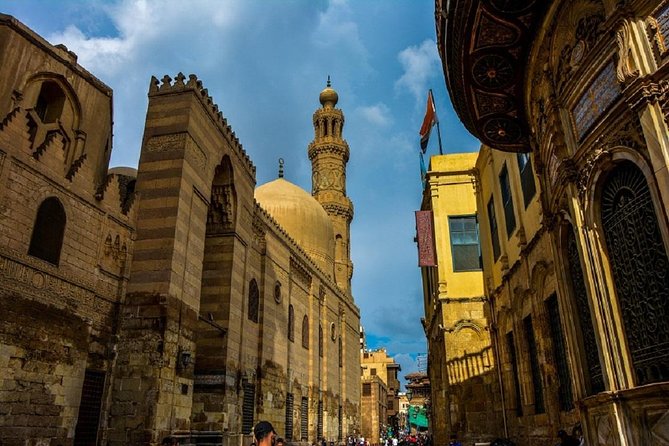
Muizz Street is the backbone of the walk. It runs for about one kilometer between Bab al-Futuh in the north and Bab Zuweila in the south, passing a dense line of medieval architecture. A United Nations study identified it as having one of the greatest concentrations of medieval architectural treasures in the Islamic world.
That sounds grand, but the experience is quite practical: you walk through a real Cairo street, with historic façades close to shops, pedestrians, and daily activity. Restoration work since 1997 improved buildings, paving, drainage, and other infrastructure, helping the street function as an open-air historic area.
This is where a private guide can keep the walk from becoming a blur of domes, arches, and carved stone. Ask your guide to point out the differences between a mosque, madrasa, mausoleum, khanqah, and sabil-kuttab. Those terms can seem like a list at first, but they describe different parts of Cairo’s social and religious life.
Plan your footwear with care. The route is a walking tour, and the street sequence matters more than sitting in one monument for a long time. Comfortable shoes will help you enjoy it rather than focus on the distance.
Bab al-Futuh and the northern wall
Bab al-Futuh is one of three surviving gates in Cairo’s old city walls. Completed in 1087, it marks the northern end of Muizz Street. Its name means Conquest Gate, and its rounded towers were built as a stronger defense than the square towers of nearby Bab al-Nasr.
Look for the practical military details. The gate included arrow slits and openings that could be used to pour boiling water or burning oil on attackers. Geometric and plant designs soften the fortress-like structure, a useful reminder that defense and decoration were not separate concerns in medieval Cairo.
The stop lasts about 30 minutes. That is enough for an explanation, photographs, and a look at the gate, but not a long architectural study. If you are particularly interested in fortifications, tell your guide early so the time can be used well.
Bab al-Futuh also gives you a clear sense of the route’s structure. You are not being driven from one isolated attraction to another. You are moving through the old city as the street itself connects the monuments.
More Private Market Tours in Egypt
- Old Cairo and Khan El Khalili Bazaar: Private Half-Day Tour
★ 4.6 · 251 reviews - Private Tour: Giza Pyramids, Sphinx, Egyptian Museum, Khan el-Khalili Bazaar
★ 4.5 · 170 reviews - Cairo: Private Half-Day Local Market and Souq Tour
★ 4.1 · 167 reviews - Private Guided Tour to Giza Pyramids Egyptian Museum & Khan El Kahlili Bazaar
★ 5.0 · 147 reviews
The Sultan Al-Ghuri Complex and its arts setting
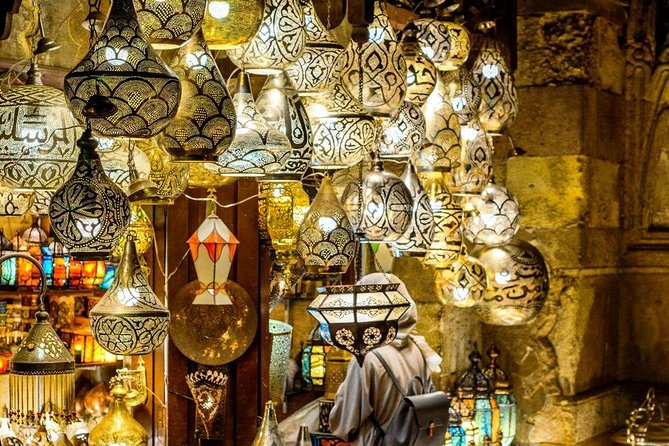
The Wekalet El Ghouri Arts Center is linked to the Sultan Al-Ghuri Complex, built between 1503 and 1505. The complex once included a khanqah, mausoleum, fountain school, mosque, and madrasa. Its parts sit on both sides of Muizz Street, with the mosque and madrasa on one side and the mausoleum, khanqah, and fountain school on the other.
That arrangement is worth noticing. The street is not merely a route between landmarks. It is part of the design, dividing and connecting the complex at once.
You have about 30 minutes here, so expect an introduction rather than a full performance or extended arts program. The arts-center setting adds a cultural layer, but the main value on this tour is seeing how a large religious and charitable complex worked as a group.
Bab Zuweila, the southern gate
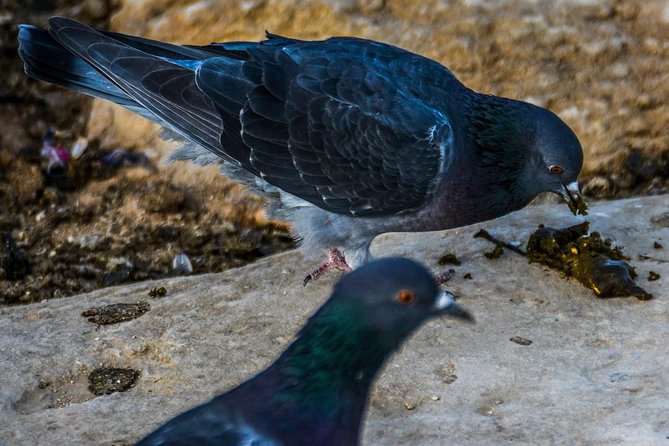
Bab Zuweila is the last surviving southern gate of Fatimid Cairo’s old walls and another 30-minute stop. It was also called Bawabbat al-Mitwali during the Ottoman period. The name combines bab, meaning door or gate, with Zuwayla, the name of a Berber warrior group from the Western Desert.
Bab Zuweila helps complete the north-to-south story of Muizz Street. At Bab al-Futuh, you begin near the northern edge of the old route. At Bab Zuweila, you reach its southern end and see how the surviving gates once controlled movement through the walled city.
The two gates are not identical, which makes the comparison useful. Bab al-Futuh is known for its rounded defensive towers, while Bab Zuweila gives you the southern gate and its own place in Cairo’s political and religious history. Your guide can help you notice the difference instead of treating both as quick photo stops.
Khan El-Khalili and the El Fishawi café stop
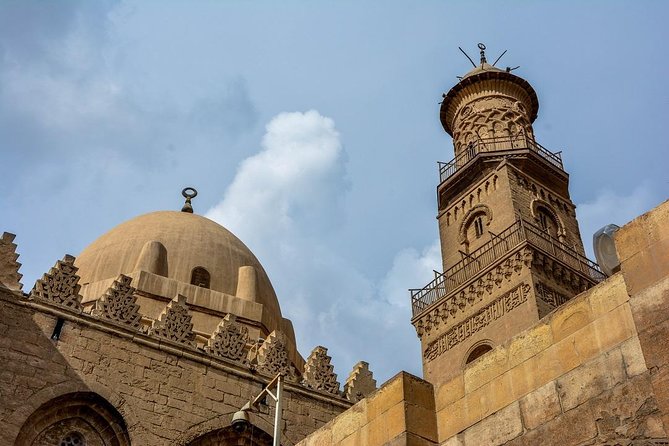
Khan El-Khalili is Cairo’s best-known bazaar district, and it is where the tour shifts from monumental architecture to shopping, street life, and negotiation. The market attracts both Egyptians and international visitors, so expect a busy setting with plenty of chances to browse.
This is the section where a guide is most useful in practical terms. You can ask for help understanding prices, finding a particular type of item, or avoiding a hard-sell approach. The tour is private, so you do not have to follow a group into every shop or spend time on purchases that do not interest you.
The route includes a non-alcoholic drink at El Fishawi café, a heritage café in the market. It is a welcome pause after the walking sections and gives you a chance to sit, look around, and take in the setting without rushing through another monument.
The bazaar stop is listed at about 30 minutes, which is enough to get a feel for the lanes but not enough for a long shopping session. If buying gifts is central to your Cairo plans, ask whether extra market time can be arranged within your private schedule. The tour has some flexibility, but the published route also has several fixed stops.
A private vehicle makes Cairo easier
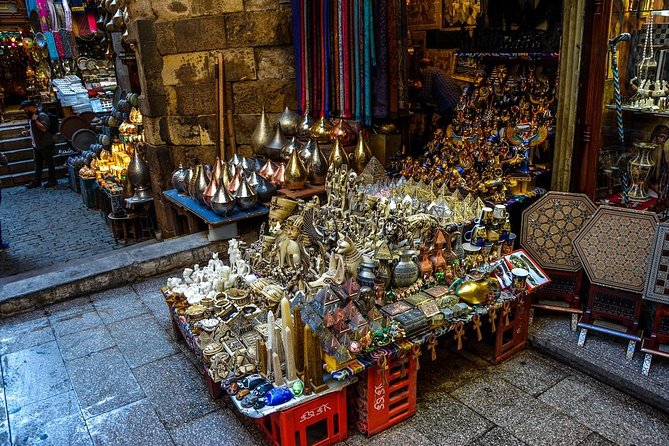
Pickup and drop-off are offered from hotels across Cairo. Your chauffeur uses a modern, air-conditioned vehicle, and Wi-Fi is available on board. Bottled mineral water is included as well.
That transport is more than a comfort feature. Cairo traffic can make even a short cross-town journey tiring, and a private vehicle lets you save your energy for the historic district. You do not need to work out metro connections or return to your hotel alone after the bazaar.
The vehicle does not remove all traffic delays. Cairo roads can still be slow, and the total duration is an estimate of four to six hours. Departure times are offered across a broad range, which helps if you are fitting the walk between a flight, hotel check-in, or another Cairo visit.
Lunch is not included. You can arrange an optional Egyptian meal at a local restaurant, with choices based on your preferences. If you want lunch, treat it as an add-on and allow extra time rather than assuming it is part of the standard four-hour route.
Is $80 per person a fair price?
At $80 per person, this is not the cheapest way to see Islamic Cairo. You are paying for a private Egyptology guide, private transport, hotel pickup and drop-off, admission at the listed stops, bottled water, Wi-Fi, and the ability to adjust the conversation and pace.
The value improves if you are traveling with a small group, since group discounts are offered and the cost of private transport is shared. For one or two people, the price is easier to justify if you place a high value on time, direct transport, and personal guidance.
You can visit parts of Islamic Cairo independently for less. The tradeoff is that you must plan the route, manage transport, understand which buildings are open, and handle the market on your own. This tour is aimed at convenience and context, not the lowest possible cost.
The rating is 4.5 from 12 reviews, which is a positive but not enormous sample. The strongest praise centers on flexible guiding, clear historical explanation, and handling Cairo traffic. Those are exactly the areas where a private tour should earn its price.
Who will get the most from this tour?
I would recommend it to a first-time Cairo visitor who wants to see several major parts of Islamic Cairo in one half-day. It suits you especially well if you prefer a private walk over a large coach group and want hotel transport included.
It is also a good fit for photographers. The guide can advise on photo angles, and the route offers gates, carved façades, narrow streets, market scenes, and large religious buildings. Just remember that crowds and activity are part of the setting, so this is not a quiet architectural photo session.
Families and mixed-interest groups may appreciate the private format. One person can ask about architecture, another about food or shopping, and the guide can adjust rather than deliver a fixed speech.
You may want another option if your main goal is a slow study of one monument, extensive shopping, or a full meal. The route covers a lot, and its strength is range.
Booking details worth knowing
Confirmation is provided when you book. The activity is private, so only your group participates, and most people can take part. It is also near public transportation, though the supplied experience itself provides private pickup and drop-off.
Free cancellation applies when you cancel at least 24 hours before the start time. Cancellations or changes made within 24 hours are not refunded or accepted, and the cut-off uses Cairo local time.
Should you book it?
Book this tour if you want a well-organized first look at Islamic Cairo, with a guide to connect the monuments and a driver to remove the transport headache. The strongest reasons are the private, adjustable format and the compact route from Bab al-Futuh to Muizz Street, Bab Zuweila, and Khan El-Khalili.
Skip it if you prefer to wander without a schedule or spend half a day in one mosque, house, or market. For everyone else, $80 per person is a reasonable convenience price, particularly for a small group that values hotel pickup, included admissions, and a guide who can adapt the walk to your interests.
FAQ
How long does the private Islamic Cairo tour last?
The tour lasts approximately four to six hours, depending on the route, traffic, and time spent at the stops.
Is hotel pickup and drop-off included?
Yes. Pickup and drop-off are offered directly from hotels across Cairo using a private, air-conditioned vehicle.
Is this a private group experience?
Yes. Only your group participates in the tour.
What is included in the tour price?
The price includes a professional licensed Egyptology guide, private transportation, an air-conditioned vehicle, onboard Wi-Fi, bottled mineral water, and admission at the listed stops. A non-alcoholic drink at El Fishawi café is also part of the experience.
Is lunch included?
No. Lunch is not included, but an optional Egyptian meal at a local restaurant can be arranged according to your preferences.
What is the cancellation policy?
You can cancel for a full refund up to 24 hours before the experience starts. Cancellations or changes made less than 24 hours before the start time are not accepted and are not refunded.
More Spice Market and Bazaar Tours in Egypt
- Cairo Sightseeing Highlights Tour Visiting Egyptian Museum Citadel with Mohamed Ali Mosque and khan khalili Bazaar
★ 5.0 · 56 reviews - Day Tour Cairo Egyptian Museum Coptic Cairo and Khan El Khalili Bazaar from Giza
★ 5.0 · 46 reviews - CairoPrivate Felucca on the Nile River and Khan El Khalili Bazaar
★ 4.5 · 32 reviews - Private Cairo City Tour: Giza Pyramids, Egyptian Museum and Khan Khalili Bazaar
★ 4.5 · 30 reviews
More Spice Market and Bazaar Tours in Cairo
- Cairo VIP Guided Tour to Khan El-Khalili Market with Lunch
★ 5.0 · 431 reviews - Visiting Egyptian Museum Citadel and Old market of Khan Khalili
★ 4.5 · 141 reviews - Full Day Tour To Giza Pyramids Egyptian Museum and Khan Khalili Bazaar
★ 5.0 · 96 reviews - Full Day Tour to Giza Pyramids, Sphinx, Egyptian Museum, Khan el-Khalili Bazaar
★ 5.0 · 73 reviews
Just added around Cairo
- Cairo layover tour Giza pyramids Egyptian museum local bazaars Camel ride Lunch★ 4.5 · 2 reviews
- Private Tour Giza Pyramids ,Egyptian Museum and Local Market★ 5.0 · 3 reviews
- VIP guided Tour Khan El Kahili Market Private Tour and Shopping★ 5.0 · 4 reviews
- Unusual Tour To The Camel Market Of Birqash★ 5.0 · 2 reviews
- Shopping tour In Governmental Bazaars include guide’s advisor★ 5.0 · 8 reviews
- Private tour to the Pharaonic Village and Khan El Khalili Market★ 4.5 · 9 reviews
- Private Walking Tour in ElMoez Street & Khan Elkhalili Market★ 5.0 · 15 reviews
- Private Cairo City Tour: Giza Pyramids, Egyptian Museum and Khan Khalili Bazaar★ 4.5 · 30 reviews
Grand Bazaar & Spice Market Tours, compared.
Dubai Half-Day City Tour with Visit to Dubai Gold Souk
Read our review →
Local Markets & Khan el Khalili Private Shopping Tour
Read our review →
Cairo VIP Guided Tour to Khan El-Khalili Market with Lunch
Read our review →
Istanbul Grand Bazaar: From Rooftops to the Secret Passages
Read our review →
Old Delhi Food-Spice Market-Temples Tour Soon Featured on NETFLIX
Read our review →Old Delhi Odyssey: A Tour of Religion, Spice Market, & Best Food
Read our review →
Old Cairo and Khan El Khalili Bazaar: Private Half-Day Tour
Read our review →